Key Takeaways
- Data readiness is not about connection demos. You need to test data quality, source-of-truth ownership, field mapping, integration behaviour, and process exceptions before platform selection, not after.
- ERP, PIM, and OMS are different integration problems. Each system drives different data flows, sync directions, and failure modes. Treating them as one generic workstream hides risk.
- Missing ownership creates hidden complexity. If pricing sits with finance, stock in operations, and product attributes across PIM and spreadsheets, nobody has the full picture. That confusion becomes scope pressure later.
- Architecture should follow constraints, not fashion. Headless commerce or platform flexibility only helps if your audit shows real custom pricing, B2B logic, or unusual API demands. Otherwise it adds operational overhead without solving the actual problem.
- A proper assessment gives you risk clarity before commitment. You should leave with a remediation plan, integration complexity view, migration assumptions, and shortlist implications in writing, not just a feeling one platform looks stronger.
The eCommerce technical decision most clients skip in scoping is the one that delays launch. Everyone assumes the ERP talks to the current store, the PIM exports product data, and the OMS handles fulfilment – so the replatform should be straightforward. That is usually where the trouble begins. What looks connected on the surface is often held together by manual fixes, brittle middleware, missing ownership, and business rules nobody ever wrote down.
Assessing data readiness and integration complexity for eCommerce platform selection means reviewing ERP, PIM, and OMS separately – checking data quality, source-of-truth ownership, field mapping depth, API behaviour, and exception handling – before any platform is shortlisted. Without that work done first, every estimate is a guess dressed up as a plan.
A credible assessment should test five things before you choose a platform: data quality, source-of-truth ownership, mapping complexity, integration behaviour, and process exceptions. It should check APIs and middleware, inspect how pricing, stock, tax, checkout, and fulfilment actually work end-to-end, then turn that into practical outputs covering migration effort, delivery risk, shortlist fit, and likely scope pressure. If a partner cannot explain that method clearly, the estimate is softer than it looks.
This guide is for technical leads and founders comparing platforms, scoping integrations, or pressure-testing shortlist decisions before discovery and supplier selection.
What a real data readiness assessment is actually trying to prove
A proper assessment is not asking whether these systems can connect at all. That is demo logic, and demos are very forgiving. The real question is whether your current data and process model can support the new platform without dragging technical debt into the build.
The joined-up test: a thorough review covers architecture, data condition, ownership, field mapping, middleware, process exceptions, and failure modes together – not in isolation. If you are only shown a feature checklist, push back. That does not tell you what breaks when returns, partial shipments, customer-specific pricing, or regional tax rules show up in production.
One pattern I see repeatedly across eCommerce development projects is this: one shortlist gets shaped by polished platform demos, the other by actual integration constraints. You want the second one. It is less flattering, but it is the one that survives first contact with your real data.
Which inputs and people are needed before anyone can judge complexity
You cannot judge integration complexity from a platform feature sheet. You need evidence. Ask for the minimum discovery inputs up front – otherwise the proposal gets built on assumptions that come back later as change requests.
At minimum, you should provide:
- Sample exports for products, customers, orders, pricing, and stock
- A simple architecture view of ERP, PIM, OMS, middleware, and storefront touchpoints
- Known business rules for tax, promotions, fulfilment, returns, and B2B eCommerce pricing
- A list of manual workarounds, spreadsheet steps, and exception handling
- Access to the people who own operations, finance, product data, and technical delivery
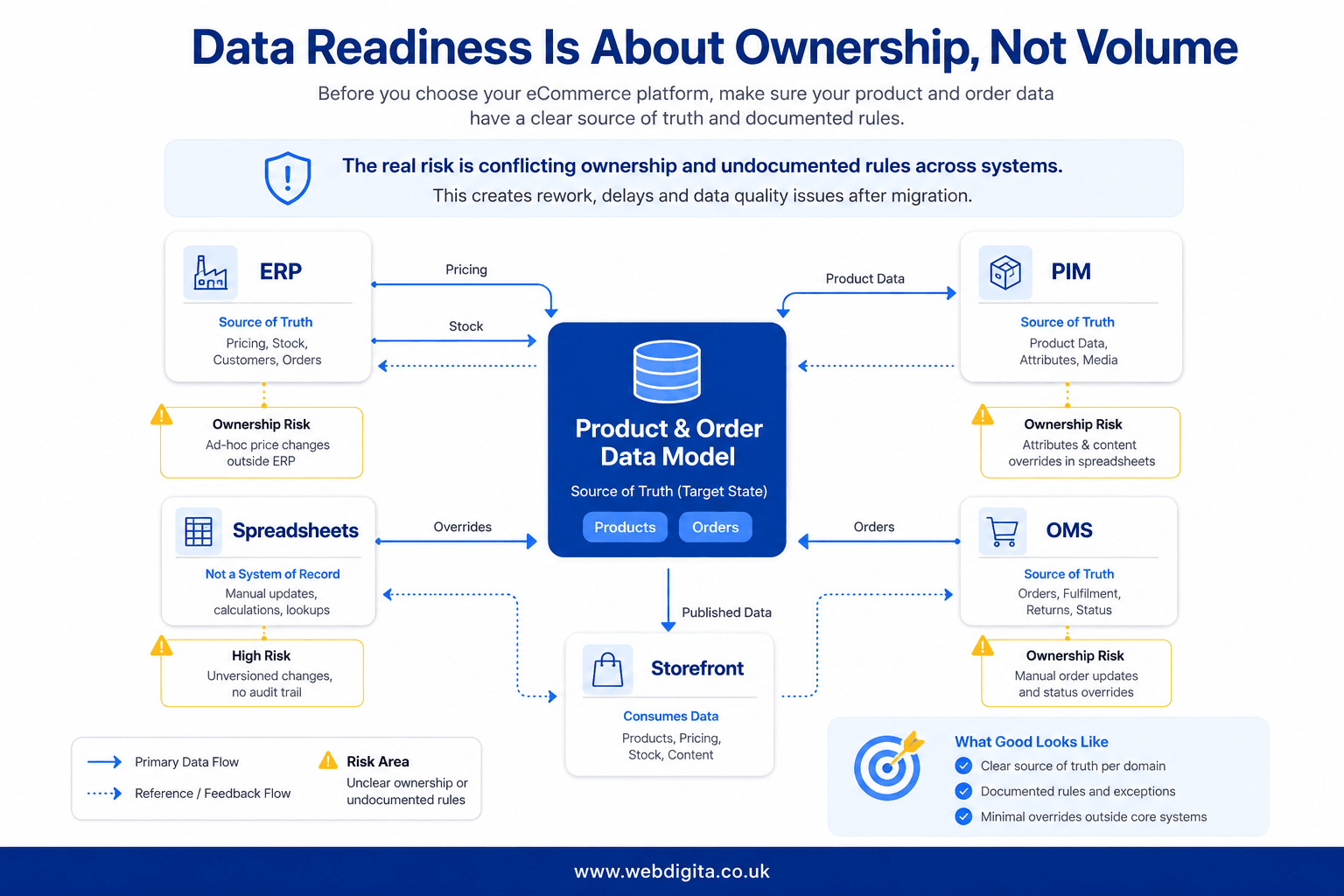
Watch for missing ownership. If pricing sits with finance, stock logic sits in operations, and product attributes are split across PIM and spreadsheets, nobody has the full picture. That is exactly why a project discovery workshop or similar in-depth scoping process matters before platform selection is locked in.
How to check data quality, structure, and ownership before migration starts
Data readiness starts with boring questions that save expensive time later. Check completeness, consistency, duplication, variant logic, category structure, attribute quality, and missing mandatory fields. Do not assume a large catalogue is a complex catalogue. Sometimes the real problem is a small catalogue with years of inconsistent rules applied by three different people who have since left.
Source of truth matters more than volume. If product content lives in the PIM, stock in the ERP, delivery promises in the OMS, and pricing overrides in spreadsheets, complexity rises fast. Ask which system owns each field, who has authority to change it, and what actually happens when values disagree.
Having reviewed builds across Shopify, Magento, and WooCommerce, the pattern I encounter most often is not a migration volume problem. It is an ownership confusion problem. Stock comes from one system, customer pricing from another, and the sales team applies manual overrides outside both. The visible brief looks manageable. The real issue is undocumented exceptions that surface mid-build.
Product data model design also affects platform fit. If you are dealing with B2B eCommerce catalogues, regional rules, bundles, or customer-group pricing, check whether the target platform can represent that cleanly without forcing awkward workarounds. Vague answers here are a warning sign – and the time to push is before contracts are signed, not after.
How ERP, PIM, and OMS integration complexity is assessed in practice
Integrations should be assessed as operating behaviour, not as a yes or no connection question. Check API maturity, mapping depth, sync direction, event timing, middleware dependencies, and exception handling. The question that exposes the most is not “can it connect?” – it is “what happens on failure?”
ERP, PIM, and OMS are different problems and need to be treated as such. ERP integration typically drives stock, pricing, finance, and order state. PIM drives catalogue structure and enrichment. OMS controls fulfilment logic, split shipments, returns, and status updates. If a supplier treats all three as one generic integration workstream, treat that as a risk flag, not a feature.

Not sure if your current systems are ready for replatforming
We can review your ERP, PIM, and OMS setup before you commit to a platform. A short technical audit checks data quality, integration constraints, and migration risk so you can shortlist with confidence instead of assumptions.
Usually takes one to two weeks depending on system access
Questions that expose hidden integration risk
Ask which fields are one-way, which are bi-directional, what triggers an update, how conflicts are resolved, and where middleware is translating or caching data. Then move to edge cases: partial orders, returns, multi-currency, regional tax rules, B2B pricing tiers, and fulfilment exceptions. That is exactly where happy-path demos stop being helpful.
If an integration only works cleanly when every order is standard, every product record is complete, and every stock update arrives on time, it is not low risk. It is only untested.
If you want to go deeper on system mapping, this guide on planning eCommerce integrations before development starts is worth reading before you sign off assumptions.
How architecture, headless commerce, checkout, and scale decisions get made
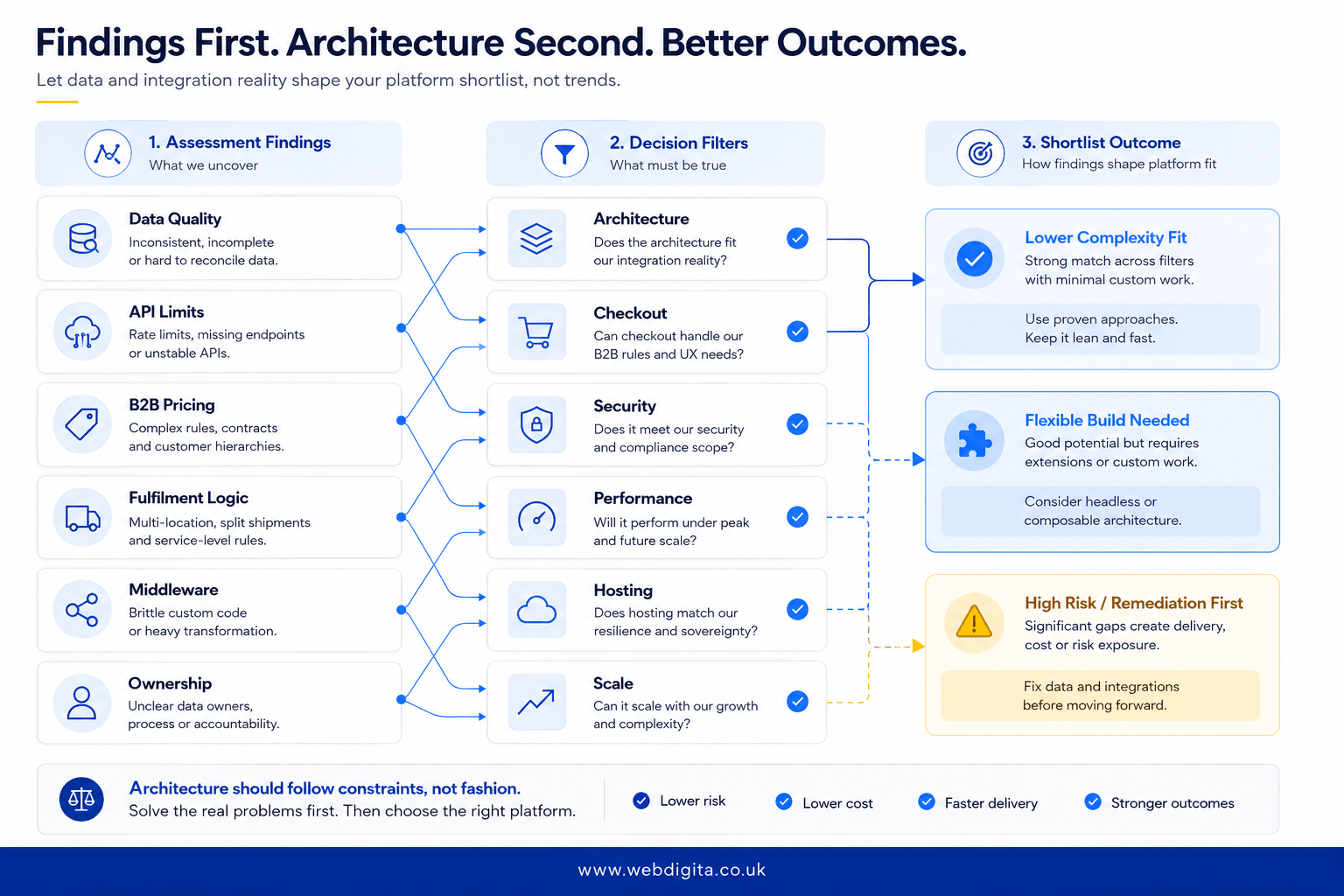
Once the data and integration picture is clear, the shortlist usually changes. This is where the headless commerce conversation either becomes justified or stops making sense.
Headless architecture is not a default upgrade. The right question is whether it solves a real customer experience or integration need – or whether it adds operational overhead your team then has to carry indefinitely. If the audit shows heavy custom pricing, B2B account logic, complex fulfilment, or unusual API demands, platform flexibility and headless capability may genuinely matter. But if the real issue is poor source data and weak process ownership, a more complex architecture will not rescue that. It will make the failure mode more expensive and harder to diagnose.
Where architecture decisions tend to go wrong in practice:
- Checkout optimisation left too late: checkout constraints, payment dependencies, and PCI scope need to be part of platform evaluation, not an afterthought after selection
- Scale assumptions untested: API rate limits, peak traffic behaviour, and load testing approach should be committed to in writing before the shortlist is final – not assumed
- Hosting reliability unverified: uptime commitments and incident response expectations vary significantly across managed and self-hosted setups; get specifics
- Compliance scope unclear: if your checkout handles card data directly, PCI scope is a build constraint, not a post-launch checkbox
For a neutral compliance reference, the PCI Security Standards Council is the right place to sense-check payment security expectations before finalising requirements.
What the final assessment should give you before you choose a platform
A proper assessment should leave you with more than a feeling that one platform looks stronger than another. You need a risk summary, remediation needs, an integration complexity view, migration assumptions, and clear shortlist implications. Get the assumptions in writing. If they stay verbal, they move.
WEBDIGITA Systems Readiness Checklist: use this to verify your brief is defined well enough to support platform selection and realistic scoping before project start.
- Named source of truth for product, stock, pricing, customer, and order data
- Key entities and mandatory fields defined, including variants and B2B structures
- Field mapping rules agreed across ERP integration, PIM, OMS, and storefront
- Integration direction and trigger logic documented for each system
- Exception handling defined for returns, partial fulfilment, failed syncs, and overrides
- Pricing, tax, currency, and regional trading rules captured clearly
- Checkout optimisation constraints, payment dependencies, and security scope agreed
- Peak-load expectations, performance risks, and testing approach stated in writing
- Ownership assigned for remediation before build and after launch
Use those outputs to challenge vague proposals, soft timelines, and suspiciously tidy estimates. And if post-launch ownership is still unclear, plan for eCommerce maintenance support early – not after the first broken sync. That is usually when maintainability becomes everybody’s priority at once.
For a useful follow-on, read reviewing integration and scope details before any quote is signed. It helps turn technical findings into better commercial decisions.
Questions teams ask before assessing data readiness for replatforming
Practical answers on integration complexity, data quality checks, and what a proper assessment should deliver before platform selection.
1. What is data readiness in the context of eCommerce replatforming?
Data readiness means checking whether your current data and process model can support the new platform without dragging technical debt into the build. It tests data quality, source-of-truth ownership, field mapping complexity, integration behaviour, and process exceptions across ERP, PIM, OMS, and middleware before you choose a platform or lock in scope.
2. Why does source-of-truth ownership matter more than data volume?
If product content lives in the PIM, stock in the ERP, delivery promises in the OMS, and pricing overrides in spreadsheets, complexity rises fast regardless of catalogue size. You need to know which system owns each field, who can change it, and what happens when values disagree. Missing ownership creates hidden integration risk that shows up as scope pressure later.
3. What inputs are needed before anyone can judge integration complexity?
You need sample exports for products, customers, orders, pricing, and stock, a simple architecture view of ERP, PIM, OMS, middleware, and storefront touchpoints, known business rules for tax, promotions, fulfilment, returns, and B2B pricing, a list of manual workarounds and exception handling, and access to the people who own operations, finance, product data, and technical delivery.
4. How should ERP, PIM, and OMS integrations be assessed differently?
ERP usually drives stock, pricing, finance, and order state. PIM usually drives catalogue structure and enrichment. OMS usually controls fulfilment logic, split shipments, returns, and status updates. Each system has different API maturity, mapping depth, sync direction, event timing, and failure modes. Treating them as one generic integration workstream hides risk and makes estimates softer than they look.
5. What questions expose hidden integration risk before development starts?
Ask which fields are one-way, which are bi-directional, what triggers an update, how conflicts are resolved, and where middleware is translating or caching data. Also ask about edge cases: partial orders, returns, multi-currency, regional tax rules, B2B pricing tiers, and fulfilment exceptions. If an integration only works cleanly when every order is standard, it is not low risk, it is only untested.
6. Should headless commerce be chosen before or after the data audit?
After. Headless commerce only helps if your audit shows real custom pricing, B2B account logic, complex fulfilment, or unusual API demands. If the real issue is poor source data and weak process ownership, a more complex architecture will not rescue that. It will only make the failure mode more expensive. Architecture should follow constraints, not fashion.
7. What should a proper data readiness assessment deliver before platform selection?
You should leave with a risk summary, remediation needs, an integration complexity view, migration assumptions, and clear shortlist implications in writing. Ask for the assumptions in writing. If they stay verbal, they tend to move later. The assessment should also clarify ownership for remediation before build and after launch, not just technical feasibility.
8. How do you check data quality before migration starts?
Check completeness, consistency, duplication, variant logic, category structure, attribute quality, and missing mandatory fields. Ask which system owns each field, who can change it, and what happens when values disagree. Also check product data model design: if you are dealing with B2B catalogues, regional rules, bundles, or customer-group pricing, verify the target platform can represent that cleanly without forcing awkward workarounds.
Conclusion
The platform decision should come after the data and integration audit, not before it. If you choose the platform first and assess readiness second, you are building the shortlist on assumptions that will resurface as change requests, scope pressure, or post-launch fixes nobody budgeted for.
| Decision point | What to check before committing |
|---|---|
| Platform shortlist | Does the audit show heavy custom pricing, B2B logic, or complex fulfilment that justifies more flexibility, or is the real issue poor source data and weak ownership? |
| Integration scope | Are field mapping rules, sync direction, exception handling, and failure modes documented clearly enough to support a realistic estimate? |
| Migration risk | Is remediation effort, ownership, and post-launch support agreed in writing, or are those still verbal assumptions that will move later? |
Ready to choose a platform that fits your actual integration constraints
WEBDIGITA helps technical teams assess data readiness, map integration complexity, and shortlist platforms based on real system behaviour. We work with ERP, PIM, OMS, and middleware across Shopify Plus, Magento, and custom builds.
See our eCommerce development servicesOr if you prefer,