Key Takeaways
Enterprise redesigns break down when internal requests outweigh user intent. Without clear decision rights and prioritisation rules, pages become compromise documents that serve politics rather than journeys.
- Separate input from decision rights: departments should contribute expertise, but not all of them should control hierarchy, prominence, or calls to action.
- Filter requests by page purpose: a valid ask can still belong lower on the page, on another template, or later in the journey if it conflicts with task completion.
- Use a stakeholder-to-journey map: define where each department can shape the experience, where they cannot override it, and when issues need sponsor escalation.
- Build sign-off flow that protects momentum: agree page purpose, audience, and primary action at wireframe stage, and do not reopen settled ground during visual review.
The fix is not more collaboration. It is clearer ownership, stronger filters, and escalation rules that stop internal debate from weakening trust, flow, and conversion quality.
If you have not solved who signs this off, you should not be choosing colours yet.
Aligning multiple departments in an enterprise redesign without compromising the user experience requires three things decided before design begins – clear decision rights, a prioritisation filter anchored to user intent, and a sign-off sequence that does not reopen settled ground. Without those, every valid departmental request competes equally, and the page stops serving a journey. It starts serving internal politics.
This guide is for enterprise sponsors, digital leads, and cross-functional teams managing conflicting stakeholder inputs during a redesign. If the pressure is to keep everyone happy without weakening trust, flow, or conversion quality – this is where to start.
Decide who owns what before anyone opens a brief
The governance problem in enterprise web design is rarely that teams have bad ideas. It is that good ideas from different departments arrive with equal weight, and without a framework to order them, the loudest voice shapes the page hierarchy rather than user intent.
Alignment improves when roles are clear – not when every department gets equal influence over every decision. Before content requests start landing, settle ownership at the structural level.
- Who owns page purpose? Someone needs to decide what the page must help the user do – and hold that decision.
- Who advises on constraints? Brand, Legal, Technical, and Commercial teams should flag limits, not control hierarchy or sequence.
- Who protects journey quality? One owner judges whether the page still flows and builds confidence at each step.
- Who signs off final trade-offs? When valid requests conflict, one decision-maker holds the final call – not the room.
Input and decision rights are different things. Departments contribute expertise, but not all of them should decide prominence, order, or calls to action. Skip this distinction and every review becomes a renegotiation – which shows up later as cluttered pages, diluted hierarchy, and slow sign-off that nobody owns.
If that structure needs to be established before briefs start circulating, a project discovery workshop surfaces assumptions and locks decision rights before they harden into design compromise.
Set a prioritisation filter before requests start to compete
Once teams begin asking for space, prominence, or additional messaging, you need something stronger than consensus. The right question is not, “Is this request valid?” Most are. It is, “Is this the right page, the right moment, and the right level of prominence for this user, at this stage?”
The filter that holds up in practice: audience intent first, then business value, then risk, then journey stage. A request can matter strategically and still belong lower on the page, on a different template, or later in the flow.
A familiar failure pattern: a lead-generation page where Sales wants a second form near the top while Product wants more explanation first. When both teams carry equal page power, the result is a crowded hero, mixed signals, and reduced trust before the user has formed a view. When requests are ordered by page purpose – build confidence before action – explanation leads, and capture follows at the right moment.
This is what robust multi-stakeholder web design UX governance actually means in practice. Not consensus theatre, but a filter that tests every request against task completion and journey logic rather than internal preference. For the strategy work that underpins these decisions, it is worth reviewing what should happen before a high-stakes redesign.

Not sure if your redesign governance is strong enough?
We help enterprise teams settle ownership, prioritisation rules, and sign-off flow before design debates begin. If stakeholder requests are starting to compete, it helps to map decision rights early.
We work with sponsors who need clarity before the next review round.
Use a stakeholder-to-journey decision map
Enterprise redesigns break down most predictably when every department gets equal page power but there is no shared user logic to arbitrate between them. That is not a people problem – it is a governance gap. And it shows on the page as friction, slower decisions, and lower-quality conversion.
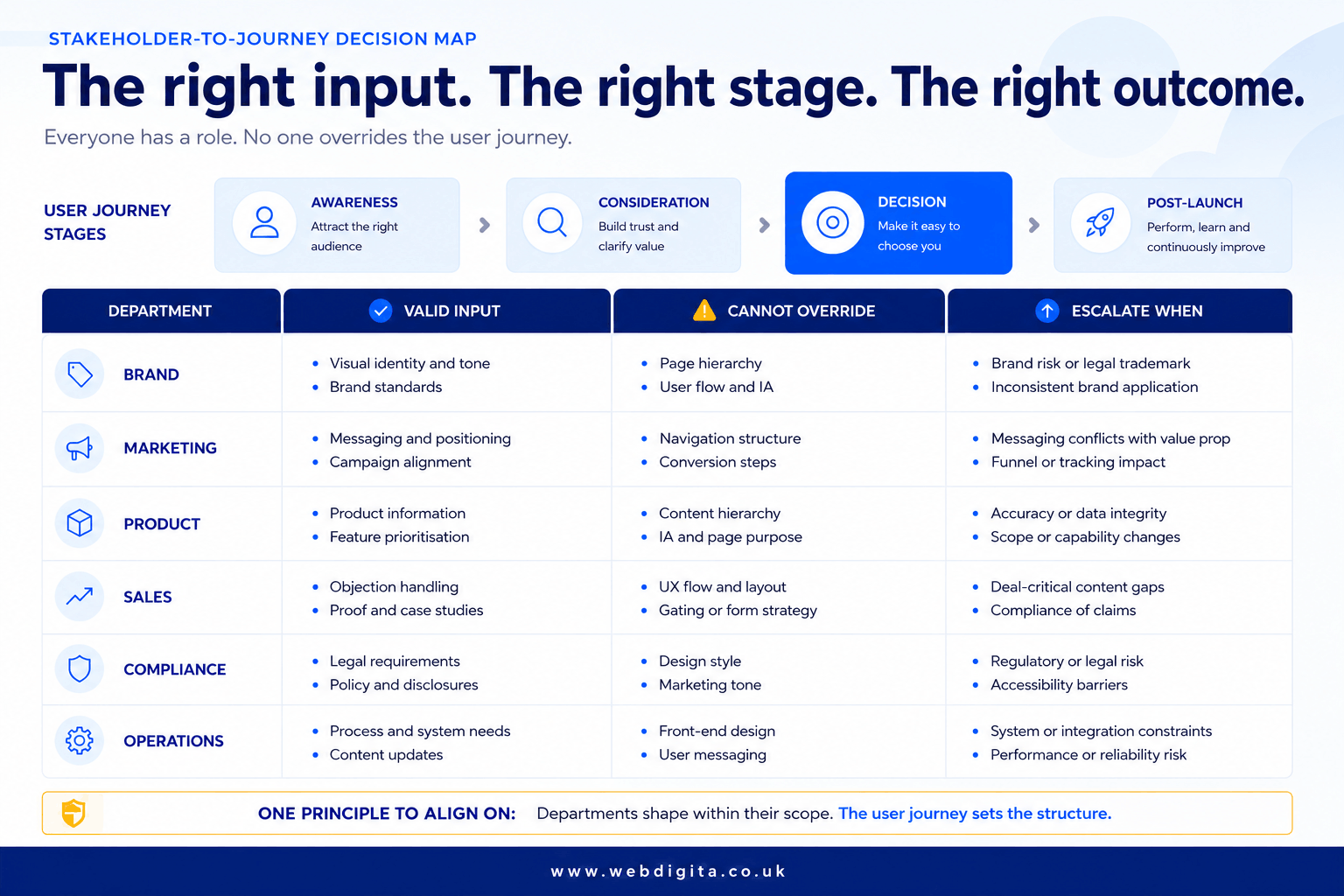
The answer is not a bigger workshop. It is a compact map showing where each department can shape the experience, where they should not override it, and what triggers escalation to the sponsor.
Stakeholder alignment-to-journey decision map
| Department | Journey stage | Valid input | Cannot override | Escalate when |
|---|---|---|---|---|
| Brand | Awareness | Tone, consistency, trust signals | Clarity of the main message | Brand rules block comprehension |
| Marketing | Awareness to consideration | Message focus, campaign fit, audience intent | Page simplicity – not secondary asks over primary purpose | Campaign goals conflict with page purpose |
| Product | Consideration | Feature explanation, proof, contextual detail | Page hierarchy – not everything at once | Extra detail delays action or creates cognitive overload |
| Sales | Decision | Reassurance, objection handling, next-step clarity | Early capture before trust is established | Lead pressure weakens conversion quality |
| Legal or Compliance | Consideration to decision | Required wording, risk controls | Usability – when mandatory copy has a less disruptive placement | Required content obscures action or flow |
| Operations or service owner | Post-launch | Content upkeep, release control, support needs | Live changes without governance | No clear owner exists after launch |
This map should stay compact. If it cannot explain who influences what in a few minutes, it is too vague to protect the journey. Its value is less as a document and more as a decision habit – tested at every review.
Define post-launch ownership with the same rigour as redesign ownership. Without it, the same governance issue resurfaces in live updates and content changes. For sites carrying transactional or operational complexity, that means clear eCommerce website maintenance governance, not informal handoffs. The logic applies equally to enterprise IA and content systems once a design system goes live.
Red flags that mean the user journey is already being compromised
By the time teams describe the process as “collaborative,” the page may already be carrying too much weight. These are the patterns worth catching early.
- Too many primary messages competing above the fold
- Repeated stakeholder rewrites with no agreed page objective
- Sign-off loops expanding rather than narrowing across rounds
- Pages structured to satisfy internal teams rather than user tasks
- Late additions that disrupt hierarchy, flow, or calls to action
If two or three of these are visible simultaneously, another review round is not the fix. Reset ownership, page purpose, and escalation rules first. When internal debate has drifted away from evidence and user logic, it helps to step back to auditing user friction before redesign decisions get locked in – and to revisit how a structured web design engagement frames governance from the start.
Build a sign-off rhythm, not just a sign-off round
The most common governance failure is not a bad process. It is a process that dissolves under pressure – because it was designed as a single approval gate rather than a sequence of staged decisions with a clear escalation path.
Good sign-off is structured around progression, not collection. It moves decisions through the right sequence at the right level, and does not reopen settled ground.
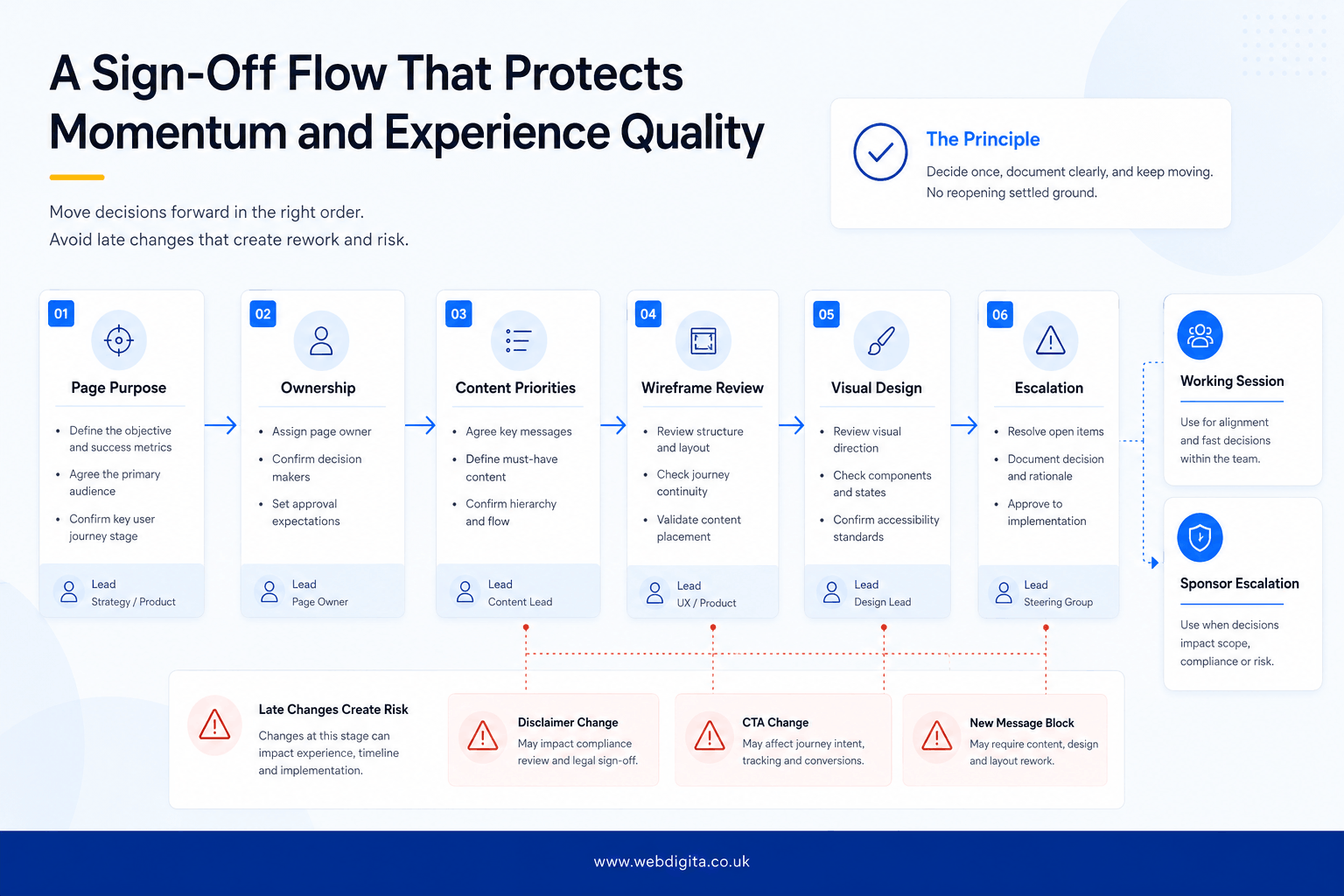
A governance rhythm that holds in practice looks like this:
- Confirm page purpose and primary audience – before content or hierarchy is discussed.
- Confirm decision rights and escalation triggers – who holds the final call on each class of conflict.
- Agree content priorities against journey logic – using the filter from the prioritisation framework.
- Review wireframes against user tasks, not departmental asks – working sessions resolve wording and hierarchy within agreed remit.
- Lock visual design and copy after wireframes are approved – purpose, audience, and primary action do not reopen at this stage.
- Reserve sponsor escalation for genuine trade-offs – compliance versus usability, or competing business goals with no clear answer from the filter.
The failure point I see most often in enterprise redesigns is a late executive or compliance request arriving after wireframes are approved. A new message block, disclaimer, or CTA is requested near the top of a page that is already signed off. The team re-enters debate, momentum stalls, and the original hierarchy is quietly compromised.
The fix is not more process. It is an explicit agreement, made before design starts, that defines what stays in working sessions and what requires escalation. Non-negotiable constraints, the primary action, and the audience definition are all locked at wireframe sign-off. Everything after that is refinement.
Where redesigns carry more complex transactional journeys, integrations, or operational dependencies, delivery planning needs to extend beyond design governance. In those cases, bringing in an eCommerce development team in London early helps formalise scope, ownership, and implementation risk before build starts.
Enterprise web design is less about screens than it is about decision structure. When governance is elegant – clear, staged, and held to user logic – departments can contribute without flattening the journey. When it is absent, the interface simply records the disagreement.
Questions teams ask before aligning stakeholders on enterprise redesigns
Practical answers on ownership, sign-off, and protecting user journeys when multiple departments want page influence.
1. Who should own page purpose in a multi-stakeholder redesign?
One person should own page purpose, usually the digital lead or product owner responsible for the user journey. That owner decides what the page must help the user do, judges whether requests strengthen or weaken that purpose, and escalates trade-offs when valid asks conflict. Departments should contribute expertise, but they should not all have equal decision power over hierarchy, prominence, or calls to action.
2. How do you stop every department demanding equal page prominence?
Use a prioritisation filter stronger than opinion. Test every request against audience intent first, then business value, then risk, then journey stage. A valid ask can still belong lower on the page, on another template, or later in the journey if it conflicts with task completion. When requests are filtered by page purpose rather than internal preference, the page becomes clearer and departments understand why their input was placed where it was.
3. What is a stakeholder-to-journey decision map?
It is a simple table that shows where each department can shape the experience, where they cannot override it, and when an issue needs sponsor escalation. For example, Brand can influence tone and trust signals at awareness stage but cannot override clarity of the main message. Sales can advise on reassurance and next-step clarity at decision stage but cannot force early capture if trust is not there yet. The map stops one page slowly turning into an internal compromise document.
4. When should you escalate a stakeholder request to the sponsor?
Escalate when valid requests conflict and cannot be resolved by page purpose alone, such as compliance wording that obscures action, campaign goals that conflict with page intent, or late executive asks that reopen settled wireframes. Do not escalate routine wording debates or preference disagreements. Reserve sponsor decisions for real trade-offs where business goals, risk controls, or journey quality are genuinely in tension.
5. How do you stop sign-off loops expanding instead of narrowing?
Agree page purpose, audience, and primary action at wireframe stage, then do not reopen those decisions during visual review. Working sessions should resolve wording, hierarchy, and evidence choices within agreed remit. If a late request arrives after wireframes are approved, test it against the original page purpose before adding it. If it weakens hierarchy or flow, it belongs elsewhere or needs sponsor escalation, not automatic inclusion.
6. What are the red flags that the user journey is already being compromised?
Too many primary messages competing above the fold, repeated stakeholder rewrites with no agreed page objective, sign-off loops expanding instead of narrowing, pages trying to satisfy internal teams rather than user tasks, and late additions that disrupt hierarchy or calls to action. If you see two or three of these together, reset ownership, page purpose, and escalation rules before continuing. Do not assume another review round will fix a governance problem.
7. Should every department get input on every page?
No. Departments should contribute where their expertise strengthens the journey, not where it dilutes it. Brand should advise on tone and consistency, Product on feature explanation, Sales on objections and reassurance, and Legal on required wording. But not all of them should decide prominence, order, or calls to action. If every department gets equal page power, the result is usually cluttered pages, mixed signals, and weaker trust.
Conclusion
Enterprise design is less about screens and more about decision structure. When roles are clear, requests are filtered by user intent, and sign-off follows a logical sequence, departments can align without flattening the journey. When those structures are missing, the interface simply records the disagreement.
- Ownership: settle who owns page purpose, who advises on constraints, and who protects journey quality before content requests start landing.
- Prioritisation: filter every ask by audience intent first, then business value, then risk, then journey stage—not by internal preference or department seniority.
- Escalation: reserve sponsor decisions for real trade-offs such as compliance versus usability or competing business goals, not routine wording debates.
- Governance: define post-launch ownership as clearly as redesign ownership, or the same alignment problem returns in live updates and support.
If your redesign needs clearer governance before departments start shaping the page
We run project discovery workshops that settle ownership, prioritisation logic, and sign-off structure before design work begins. The session helps enterprise teams align on page purpose, decision rights, and escalation rules without weakening the user journey.
See how discovery workshops workOr if you prefer to talk first,