Key Takeaways
Channel expansion only works when it adds incremental demand at workable margin, not when it spreads the same customers across more touchpoints. Most failures happen because teams add surface area before fixing weak conversion, poor retention, messy attribution, or operational gaps.
- Commercial fit matters more than reach. Check margin after fees, discount pressure, fulfilment load, and pricing control before committing budget or stock.
- Test with tight scope and clear ownership. Assign one person to execution and one to reporting, then measure margin, CAC efficiency, and contribution to LTV rather than vanity reach.
- Scale only if demand is incremental. If the new channel mostly pulls in buyers who would have converted anyway, you are not expanding growth—you are making measurement harder and margin worse.
- Fix the base model first. If stock accuracy, returns handling, or offer clarity already struggle under current demand, expansion will multiply the same weakness across more places.
The right sequencing is to stabilise margin, ops, and role clarity before adding channels, not use expansion to avoid harder fixes.
More channels can increase revenue or spread the same team too thin. The difference is sequencing, not ambition.
If you are weighing channel upside against team strain, pricing control, and operational drag, the real question is this: does the next channel add profitable demand, or just spread the same business thinner?
The short answer: Adding more channels increases growth when incremental demand is real, margin holds after fees and fulfilment costs, and ownership is clear before launch. It creates drag when the base model is unstable, customer overlap is high, or no single person owns execution and reporting. Get the sequencing right and you reach new demand. Get it wrong and you add margin loss, fulfilment strain, and one more place for the customer experience to slip.
When adding a channel actually helps
A new channel earns its place when it adds demand, not just activity. Start with a blunt question: will this reach buyers you are not already capturing, or just reshuffle the same customers across another touchpoint?
Commercial fit comes first. Check margin, fee structure, discount pressure, and returns behaviour before you get excited by reach. A channel can look attractive on paper and still be worse for the business if it strips pricing control or pushes fulfilment costs up. If expansion also means platform changes or integration work, that is where proper eCommerce strategy consulting should be part of the decision early – not bolted on later alongside the eCommerce website development project.
There is a meaningful difference between adding from a stable base and adding on top of a mess. If your core channels already convert cleanly, reporting is trusted, and one paid route carries too much concentration risk, a second channel can reduce exposure. If the current setup is already leaking margin and nobody owns optimisation, the new channel usually gives the same team one more place to underperform.
- Customer demand is meaningfully different, not heavily overlapping
- Margin still holds after channel costs and service load
- Product fit is clear for that buying context
- One person or team owns execution, reporting, and optimisation
Which channels earn the right to be added
You do not need a long list of channels. You need a way to judge them. The better question is not which channels are popular, but which one fits your product, buying journey, and current growth model without creating avoidable drag.
Judge fit, not hype. Compare channels against AOV, repeat purchase potential, brand control, and the role they play in retention. Also check whether the channel works with what you already have in place – email automation, paid traffic, landing pages, and attribution. A channel with lower reach but cleaner economics often beats a bigger one that muddies everything.
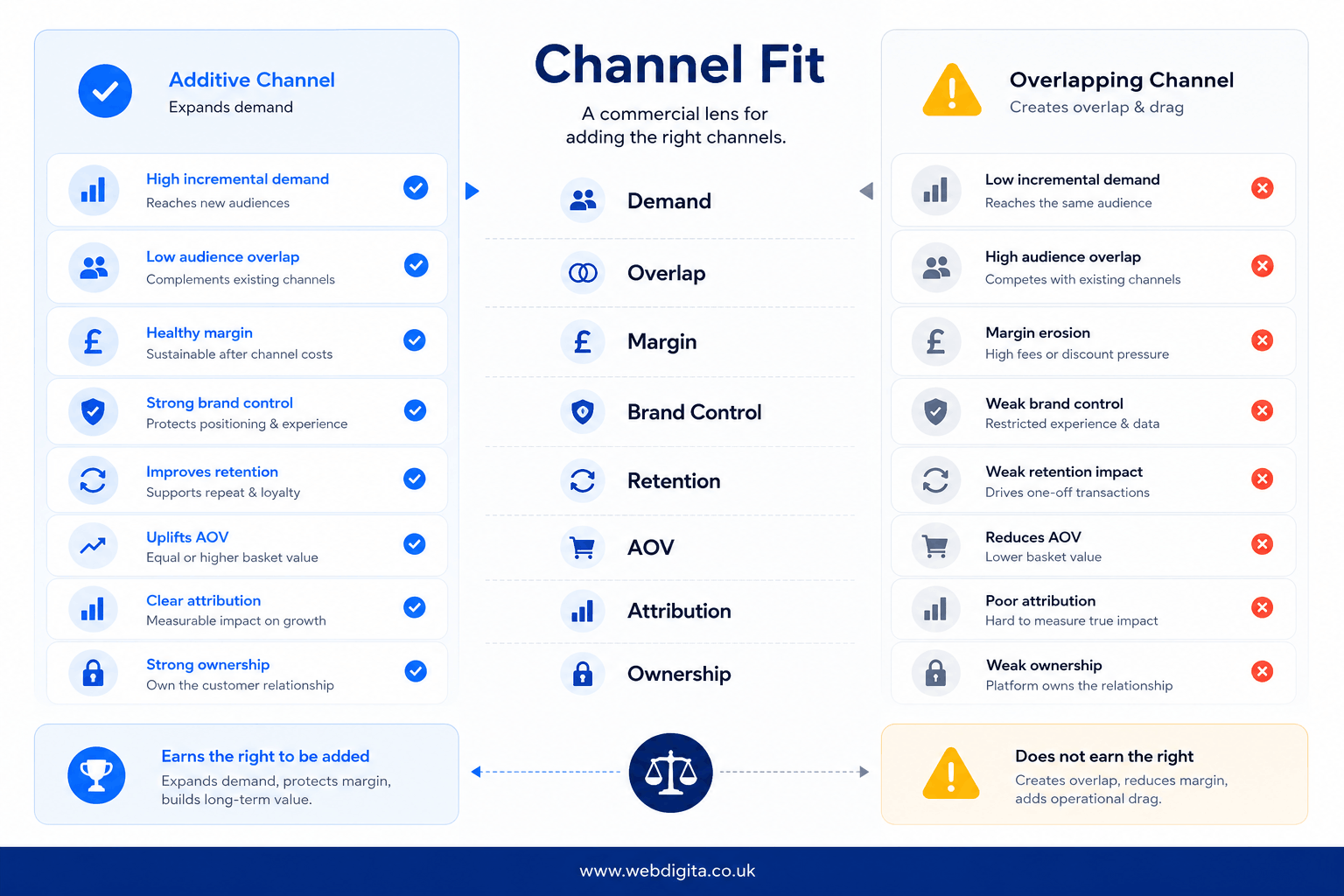
A common mistake is paying twice to reach the same customer. A brand adds a marketplace or new paid channel, only to find it mostly pulls in buyers who would have converted direct anyway – but at worse margin. When LTV assumptions are built on blended data, this problem stays invisible until the channel is already embedded. If overlap is high, the multi-channel growth strategy is not expanding demand – it is making attribution harder and margin harder to trust. That is usually where the real issue behind scaling without eroding margin starts to surface.
- Does this channel match how the product is researched and bought?
- Will it improve acquisition, retention, or both?
- Can you control pricing, offer structure, and brand presentation?
- Is the likely demand incremental, or mostly overlap with existing traffic?
Channel expansion matrix: revenue upside versus complexity cost
Use this to stop vague channel debates. Before you commit budget, stock, or team time, sort the next option by likely revenue upside and complexity cost.
WEBDIGITA Channel Fit Matrix: a quick way to pressure-test margin, fulfilment load, pricing control, reporting clarity, and ownership before launch.
| Position | What it looks like | What you need to check | Best decision |
|---|---|---|---|
| High upside, low complexity | Good margin, clear ownership, manageable fulfilment, low customer overlap | Check reporting rules and keep launch scope tight | Test soon |
| High upside, high complexity | Strong demand potential but heavier stock, service, pricing, or integration pressure | Confirm who owns ops, data, pricing, and channel execution | Test only with tight scope |
| Low upside, low complexity | Easy to launch but limited incremental demand | Check whether it is worth the distraction | Usually deprioritise |
| Low upside, high complexity | Weak margin visibility, messy reporting, channel conflict, high service load | Treat this as a warning sign, not an opportunity | Reject for now |
If a channel lands in the high-upside, high-complexity box, pause before anyone starts promising rollout dates. Test it narrowly if ownership is clear and the economics still hold. If margin, reporting, or operational assumptions are fuzzy, push it back or run a project discovery workshop first. If it sits in low-upside, high-complexity, do not dress it up as experimentation. It is a bad trade.

Not sure which channel to test next?
We help eCommerce brands map channel fit before launch. Our channel growth strategy review checks margin, overlap, fulfilment load, and reporting clarity so you add demand instead of drag.
Clear next steps in one session, no long proposals.
The red flags that turn expansion into drag
Most channel problems do not start with the channel. They start with weak control. If pricing is inconsistent, stock is unreliable, or ownership is already vague, expansion will magnify that.
Watch for these red flags:
- Margin by channel is unclear or hidden behind blended reporting
- Pricing control is weak, so offers drift and channel conflict starts
- Fulfilment, returns, or stock accuracy already struggle under current demand
- No clear owner exists for execution, reporting, and optimisation
- Brand experience changes too much across landing pages, offers, or service levels
If you cannot explain who owns the channel, how success will be measured, and what happens to margin after fees and service load, you are not ready to expand. You are ready to create rework.
This is where things usually go wrong. A team adds a new route to market while stock accuracy is already shaky, returns are slow, and discounting is handled differently in each place. Revenue may climb for a while, but service pressure rises, margin gets harder to trust, and nobody can tell whether the growth is real or cannibalised.
Why channel expansion fails when the base is unstable
The pattern I have seen consistently across channel reviews is this: expansion only paid off when margin, ops, and role clarity were already stable before the new channel went live. When those three conditions were not in place, adding a channel did not solve the underlying problem – it scaled it.
The reason this matters is not obvious until you have seen it play out. A business with weak conversion rates adds a marketplace to chase volume. The marketplace brings sales, but at lower margin and with a different returns profile. Attribution gets murky. The team splits attention between two sets of reporting. The original conversion problem is still there, now competing for resource with channel ops.
Channel expansion often gets used to avoid harder fixes. It is easier to add surface area than to deal with weak offer clarity, poor retention, messy attribution, or operational gaps. But the new channel inherits the same weakness – just in a new context.
The sequencing should be:
- Fix conversion before adding reach – a leaky funnel scaled across two channels leaks more
- Fix retention before adding acquisition – CAC efficiency falls apart if LTV assumptions are wrong
- Fix attribution before adding channels – blended reporting makes the next decision harder, not easier
- Stabilise ops before expanding fulfilment surface – stock accuracy and returns need to hold before load increases
If any of those sound familiar, why growth stalls after early traction is usually the more useful read before committing to new channels.
How to test a new channel without creating a mess
If expansion still looks justified, keep the test narrow. You do not need a full multi-channel programme to learn one thing. Pick one channel, one product set, one audience slice, or one offer structure – then measure it properly.
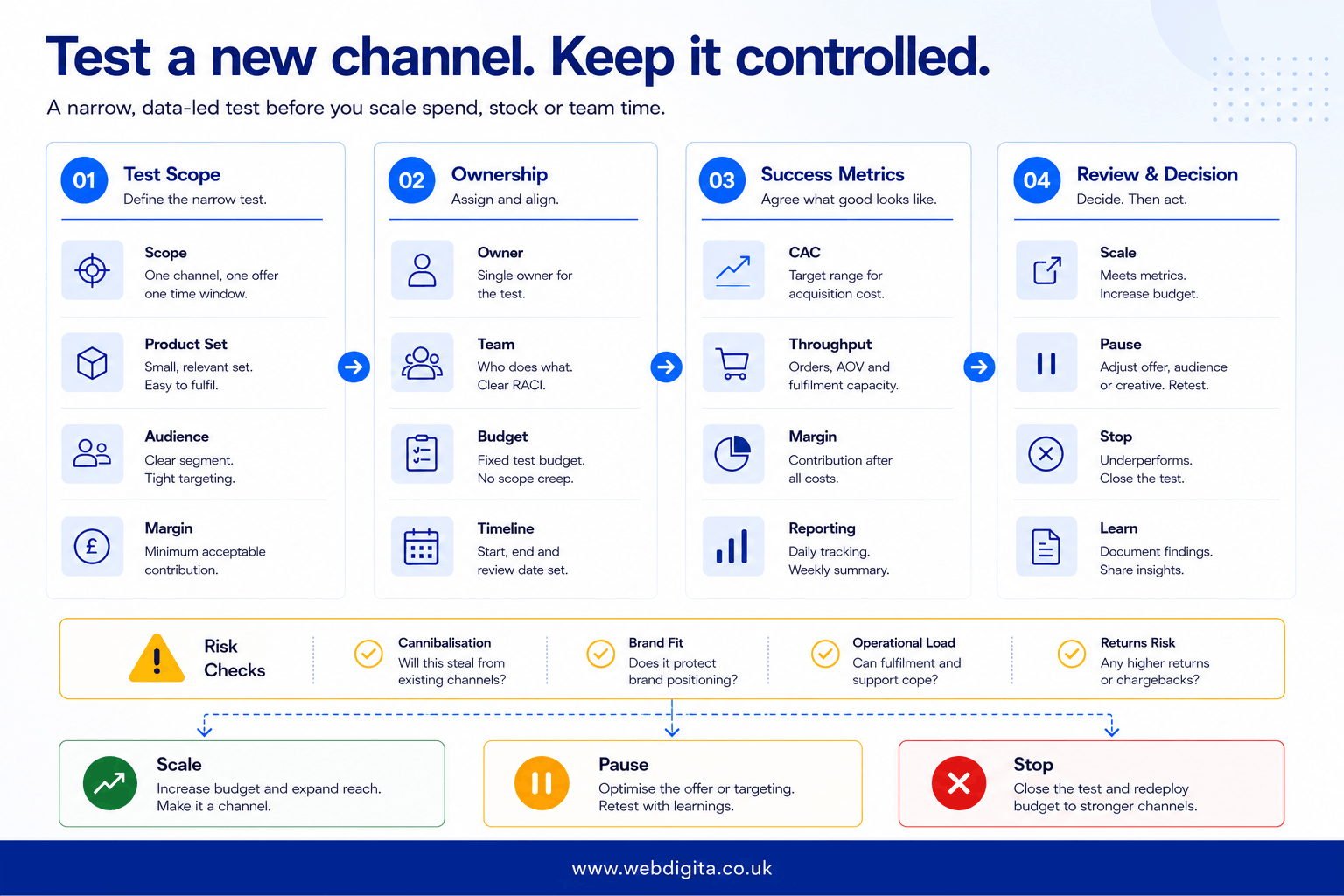
Define success before launch. Use commercial measures that actually matter – margin, CAC efficiency, fulfilment throughput, repeat purchase potential, or contribution to LTV. Do not let vanity reach or top-line revenue become the only scorecard.
- Set a tight test scope with clear limits
- Assign one owner for execution and one owner for reporting
- Agree what would make you scale, pause, or stop before launch
- Review impact against existing demand, not in isolation
Scale if the channel adds incremental demand at workable margin and the team can absorb it. Pause if demand looks promising but service load, pricing control, or reporting needs fixing first. Stop if it mostly cannibalises existing sales or creates more operational drag than it is worth.
If the current journey still struggles to convert, expert driven eCommerce CRO service will often have more leverage than another channel launch. And if you want a clearer next step, a channel growth strategy review should tell you whether the next channel is genuinely additive, what it will cost operationally, and what needs fixing first if the answer is not yet.
Related reading: what actually moves revenue in complex eCommerce buying journeys.
Questions teams ask before expanding to new channels
Common decision points around margin, ops readiness, and channel fit before launch.
1. How do I know if a new channel will add incremental demand or just cannibalise existing sales?
Check customer overlap first. If the new channel mostly reaches people who would have bought direct anyway, it is not expanding demand—it is splitting the same revenue across worse margin. Look at audience behaviour, search intent, and buying context. If the channel attracts a meaningfully different segment or solves a different use case, it is more likely to be additive. Test with a narrow product set and measure whether AOV, repeat rate, or customer profile differs from your core channels.
2. What margin checks should I run before committing to a new sales channel?
Calculate margin after platform fees, payment processing, fulfilment costs, returns handling, and any discount or promotional pressure the channel creates. Also factor in the cost of stock allocation, customer service load, and reporting overhead. If margin after all channel costs is weaker than your direct route and demand overlap is high, the channel will likely erode profitability rather than improve it. Compare net contribution, not just top-line revenue.
3. Should I fix conversion and retention issues before adding more channels?
Yes. If your core channels already struggle with weak conversion, poor repeat purchase, or messy attribution, adding another channel will multiply those problems across more touchpoints. Fix the base model first. Stabilise offer clarity, improve landing page performance, sort reporting rules, and get retention working before you expand surface area. Channel expansion works best when the foundation is already stable and profitable.
4. How do I test a new channel without creating operational chaos?
Keep the test scope tight. Pick one product set, one audience slice, or one offer structure, then assign clear ownership for execution and reporting. Define success criteria before launch, such as margin threshold, CAC efficiency, or repeat purchase rate. Set decision rules for what would make you scale, pause, or stop. Review impact against existing demand to check whether the channel is genuinely incremental or just reshuffling the same customers.
5. What are the biggest red flags that a channel will create more drag than upside?
Watch for unclear margin by channel, weak pricing control, fulfilment or stock accuracy issues under current demand, no clear owner for execution and optimisation, and inconsistent brand experience across touchpoints. If you cannot explain who owns the channel, how success will be measured, and what happens to margin after fees and service load, you are not ready to expand. You are ready to create rework and reporting noise.
6. When does it make sense to add a marketplace or third-party platform?
Add a marketplace when it reaches a meaningfully different audience, your product fits the buying context, and margin still holds after fees and service load. Avoid it if pricing control is weak, brand presentation matters heavily, or the platform mostly attracts customers who would have bought direct anyway. Marketplaces work best for products with strong repeat potential, clear differentiation, and where the platform's audience genuinely expands your addressable market rather than cannibalising existing demand.
7. How do I measure whether a multichannel strategy is actually working?
Track margin by channel, customer acquisition cost, repeat purchase rate, and contribution to lifetime value. Also measure customer overlap across channels and check whether new channels are adding incremental demand or just splitting existing revenue. Avoid relying on blended reporting or vanity reach metrics. The best measure is whether total profit grows faster than operational complexity, and whether each channel can be optimised independently without creating conflict or reporting confusion.
Conclusion
The best multichannel growth strategy is not the one with the longest channel list. It is the one where each channel adds profitable demand without creating avoidable drag, and where margin, ops, and reporting stay trusted as you scale.
- Judge fit before hype. Compare each option against AOV, repeat potential, pricing control, and the role it plays in retention, not just reach or platform popularity.
- Keep tests narrow and decision rules clear. Define what would make you scale, pause, or stop before launch, then review impact against existing demand rather than in isolation.
- Fix leaks before adding pipes. If conversion is weak, retention is poor, or reporting is muddy, those issues will follow you into the next channel and make everything harder to optimise.
- Assign real ownership. One person should own execution, one should own reporting, and both should know what success looks like before the channel goes live.
Ready to scale your eCommerce business without spreading too thin?
WEBDIGITA builds eCommerce platforms that support multi-channel growth without creating operational mess. We handle platform development, integration, and CRO so your channels work together instead of against each other.
See our eCommerce development workOr if you need clarity first,