Key Takeaways
Growth usually breaks the stack at the handoffs between systems rather than inside the storefront itself. The parts that fail first are reporting trust, integration brittleness, inventory sync, CRM confidence and workflow automation, because these layers struggle to stay aligned as channels, orders and exceptions multiply faster than ownership can keep up.
Diagnosis before tooling: Most teams overbuy when they feel strain, adding more apps and creating more overlap instead of fixing the operating model. Review the stack by failure cost and decision delay rather than by which tool is oldest, because the real blocker is usually poor data trust and fuzzy system ownership rather than missing features.
Rationalise versus replace: Rationalise when the platform still fits but the surrounding stack has become messy or duplicated. Replace only when the core architecture cannot support the required workflows or data model without constant manual rework. Challenge any replatform recommendation if the current pain is really about reporting distrust, stock mismatch and automation sprawl.
Most eCommerce brands do not hit a platform ceiling first. They hit an operations ceiling – when revenue grows faster than system ownership, data confidence and workflow control. Reporting turns up late. Inventory disagrees across channels. CRM segments become arguable. The team starts holding trading together with exports, workarounds and memory.
The short answer: The parts of the eCommerce tech stack that fail first as a brand scales are reporting and attribution, integrations and inventory sync, CRM and retention data, and workflow automation. They fail because growth adds channels, orders, exceptions and people faster than the systems stay aligned. The damage shows up as slower decisions, missed retention opportunities and margin leakage – long before revenue stalls.
This guide is for operators, eCommerce managers and growth leads who need cleaner diagnosis before a systems review, tooling decision or scaling fix.
Which parts of the eCommerce stack fail first
The first break points are rarely the ones people blame in the meeting. Failure shows up in the handoffs between systems, not in the storefront itself.
Reporting and attribution trust: If paid traffic, CRO and retention decisions depend on numbers nobody fully trusts, growth slows fast. When attribution, order data and customer data do not line up across platforms, every decision takes longer and every budget debate costs more.
Integrations and inventory sync: More channels, more orders, more exceptions. Stock mismatches, delayed order status updates and manual fulfilment fixes are usually signs the integration layer is brittle – not just busy. AOV and LTV metrics become unreliable when the data underneath them is fragile.
CRM, automation and retention stack: Loyalty, subscriptions and email automation tools often look fine at low complexity, then start fighting each other as customer states, offers and product logic multiply. Retention leakage is almost always invisible at first. By the time it shows up in LTV trend lines, six months of recoverable revenue have already gone.
Merchandising and landing pages: When promotions, sorting rules and bundles require too many people to manage, speed collapses. The team stops testing because the cost of each test is too high. That is a growth ceiling disguised as a resourcing problem.
The stack rarely breaks where the team first points the finger. It breaks where ownership is fuzzy and data arrives late.
The signs your eCommerce stack is holding growth back
You can usually spot this before revenue stalls completely. The symptoms look operational, so teams miss the systems cause until it is expensive.
If your team exports data into spreadsheets to reconcile orders, stock, campaign results or customer segments, that is not a process problem. That is a systems warning. If merchandising changes take too long to publish, or subscription and loyalty rules need manual checking before they can be trusted, you are carrying process debt inside the stack.
- Channel inventory does not match what the warehouse or ERP says
- Campaign reporting arrives too late to act on – paid traffic decisions slip by days
- CRM segments are doubted or manually cleaned before email automation runs
- Orders or refunds need repeated manual intervention
- Promotions, bundles and product sorting take too many people to manage safely
The pattern of failure I keep seeing is a normal trading week where nothing looks broken in isolation, but every team is waiting on someone else to confirm the numbers. Marketing holds spend decisions. Operations double-checks stock. Retention pauses automation because nobody wants to fire the wrong offer at the wrong customer. Meanwhile, AOV and conversion rate data sits in three different places and nobody agrees which one is right.
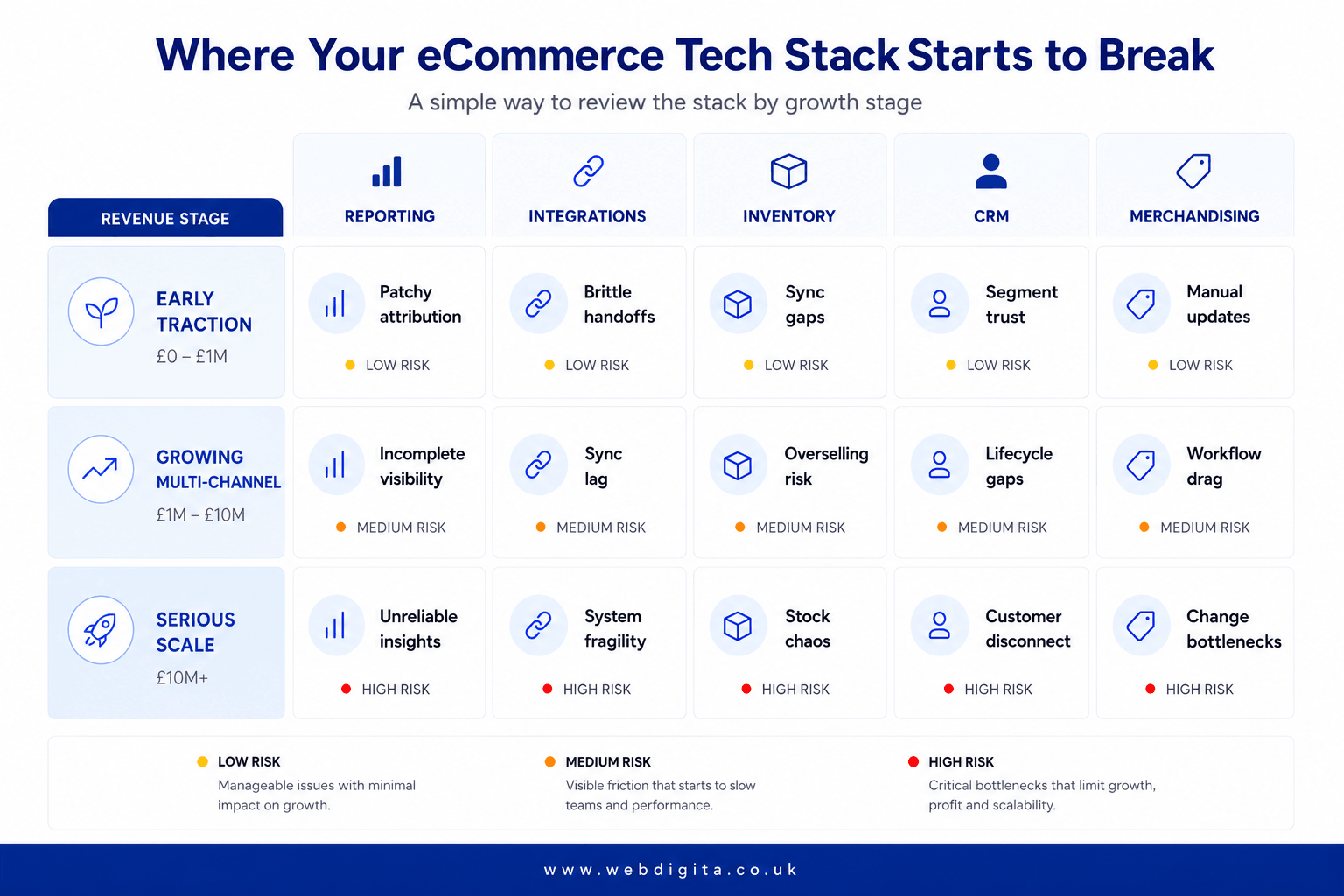
Ask where manual fixes happen every week and who owns each system handoff. Duplicated tools are not harmless. They create just enough confusion to slow throughput without triggering a formal incident.
If you want a sharper frame on the wider pattern, start with eCommerce strategy consulting – the conversation usually surfaces the real bottleneck faster than another internal audit. It also helps to understand why growth stalls after early eCommerce success.

Not sure which part of your stack is slowing growth first?
Most teams blame the platform when the real issue is reporting distrust, brittle integrations or fragmented ownership. We help operators diagnose where the bottleneck actually sits before you scope fixes or buy more tooling.
Clear diagnosis before decisions. No guesswork, no generic audits.
A compact diagnostic: stack bottlenecks by growth stage
You do not need a giant audit. You need a compact view of where complexity starts outrunning control.
My view, having reviewed stacks across brands from early traction to serious multi-channel scale, is that the bottleneck almost always sits in the layer the team stopped questioning. Not the most recent tool added. The one that was good enough two years ago.
Use this to check which layer is most likely slowing decisions before you scope fixes or buy more tooling.
Growth stack layer diagram: where bottlenecks emerge by revenue stage
| Revenue stage | Reporting and attribution | Integrations | Inventory and fulfilment | CRM and retention | Merchandising and landing pages |
|---|---|---|---|---|---|
| Early traction | Basic reporting works, attribution already patchy | Simple app connections fine until exceptions appear | Low order volume hides sync gaps | Email automation works, customer states manageable | Manual product updates still tolerable |
| Growing multi-channel | Conflicting numbers slow paid traffic and CRO decisions | Latency and brittle handoffs start showing | Stock accuracy becomes commercially critical | Segments, flows and retention logic become harder to trust | Promotions, sorting and bundles take too long |
| Serious scale | Decision-making suffers without governed attribution and AOV data | Integration ownership becomes a board-level risk | Fulfilment exceptions and overselling hit margin | Retention stack complexity creates LTV leakage and overlap | Manual merchandising caps testing speed and landing page iteration |
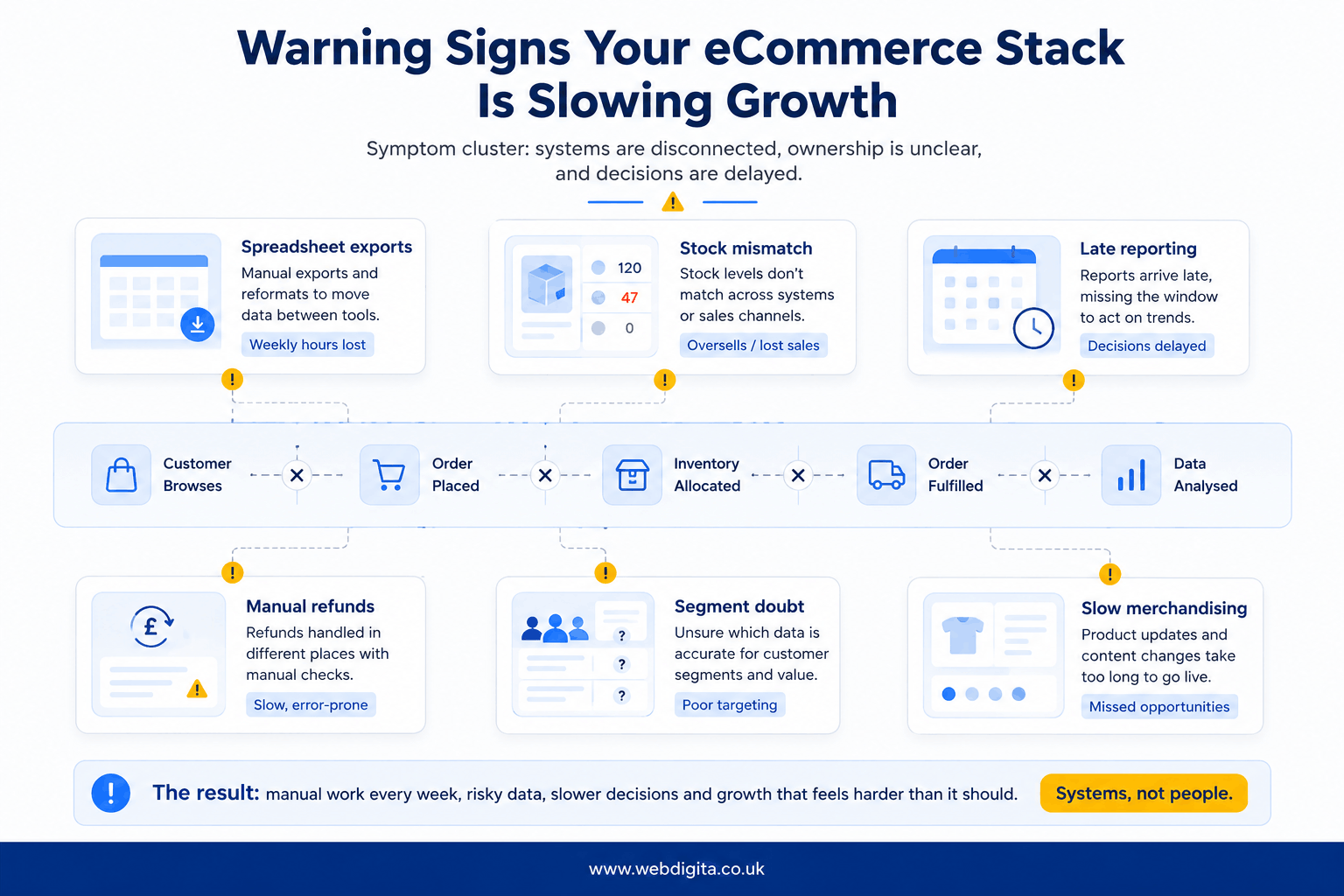
Review this by failure cost, not by which tool is oldest. The layer creating the biggest delay, the most manual rework and the least trusted data is where the next pound of effort belongs.
What to rationalise now – and what can wait
Most teams overbuy when they feel the strain. More tooling, more overlap, less clarity. I have seen this end badly enough times that I will say it plainly: buying another app is usually the wrong answer.
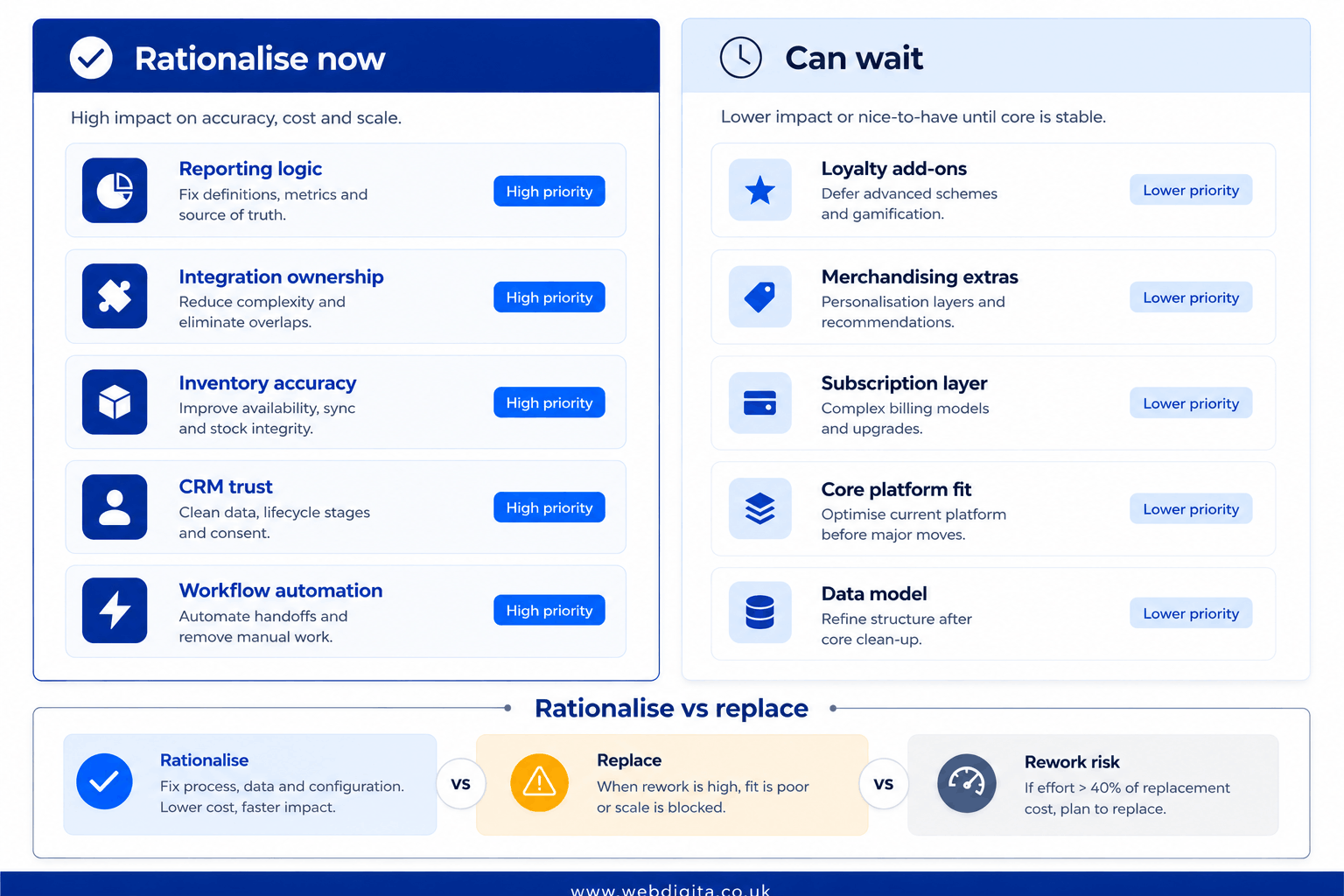
Fix now – no exceptions: reporting logic and attribution, integration ownership, inventory accuracy, CRM trust and core workflow automation. If these are weak, fix the operating model before adding anything. The bottleneck I see most often is not a lack of ideas or budget. It is fragmented tools and poor data trust making every decision slower and every campaign less confident than it should be. The visible request is usually for new features. The real blocker is that nobody can say which system owns the truth.
What can wait: extra loyalty complexity, more advanced merchandising tooling, another subscription layer – if the basics are stable. Not every growth problem needs replacement. Sometimes the right move is to remove duplicate tools, tighten ownership and document the handoffs.
Rationalise versus replace: rationalise when the core platform still fits but the stack around it has become messy, duplicated or poorly owned. Replace when the platform or architecture cannot support the required workflows, data model or operational load without constant rework. I will challenge any recommendation to replatform if the real pain is reporting distrust, stock mismatch and automation sprawl. Those are fixable without starting over.
If integrations are the weak point, this guide on planning eCommerce integrations before they become a scaling problem is worth your time before any scoping conversation starts.
If you are deciding what to do next, get a systems and growth review that maps dependencies, ownership and failure cost before anyone starts selling a shiny fix. If the core issue is keeping the store stable while you clean up the stack, eCommerce maintenance matters more than another rushed add-on. And if you are already talking to agencies about rebuilds or major changes, make sure they can diagnose the operational layer as well as the build layer. Good eCommerce development in London starts with that reality.
Related reading: what to fix before pushing eCommerce growth harder.
Questions teams ask before reviewing their eCommerce tech stack
Common concerns about diagnosing stack bottlenecks, deciding what to fix first, and avoiding costly overbuy decisions.
1. How do I know if my eCommerce tech stack is holding growth back?
Your stack is likely holding growth back if your team regularly exports data into spreadsheets to reconcile orders, stock or campaign results, if CRM segments need manual cleaning before sends, or if merchandising changes take too long to publish. Watch for inventory mismatches across channels, delayed reporting that arrives too late to act on, and orders or refunds that need repeated manual intervention. These symptoms show that complexity is outrunning system ownership and data trust.
2. Which parts of the eCommerce stack usually fail first?
The first failures usually happen in reporting and analytics trust, integrations and inventory sync, and CRM and retention automation. These layers fail first because growth adds channels, orders, exceptions and people faster than the systems can stay aligned. The damage shows up as slower decisions, lower throughput, missed retention opportunities and margin leakage. The storefront itself rarely breaks before the handoffs between systems do.
3. Should I rationalise my tech stack or replace the platform?
Rationalise when the core platform still fits but the stack around it has become messy, duplicated or poorly owned. Replace when the platform or architecture cannot support the required workflows, data model or operational load without constant manual rework. Most teams overbuy when they feel strain, adding more apps instead of fixing the operating model. Challenge any replatform recommendation if the current pain is really about reporting distrust, stock mismatch and automation sprawl.
4. What should I fix first in my eCommerce tech stack?
Fix the layer that creates the biggest decision delay, the most manual rework and the least trusted data. In most cases, that means reporting logic, integration ownership, inventory accuracy, CRM trust and workflow automation. Do not assume every growth problem needs replacement. Sometimes the right move is to remove duplicate tools, tighten ownership and document the handoffs properly before adding more complexity.
5. How much does it cost to rationalise an eCommerce tech stack?
The cost depends on the scope of the review, the number of integrations, and whether you need to rebuild workflows or just tighten ownership. A systems and growth review that maps dependencies, ownership and failure cost typically sits in the lower five-figure range for a serious multi-channel brand. If the work includes integration fixes, reporting cleanup and CRM rationalisation, expect a modest ongoing support budget rather than a one-off project cost.
6. What is the difference between a platform problem and a stack problem?
A platform problem means the core eCommerce system cannot support the required workflows, data model or operational load without constant workarounds. A stack problem means the platform is fine, but the surrounding tools, integrations and automation layers have become messy, duplicated or poorly owned. Most brands hit a stack problem first, where growth breaks the handoffs between systems rather than the storefront itself.
7. Can I fix my eCommerce tech stack without replatforming?
Yes, if the core platform still fits your operating model and the real pain is poor integration ownership, reporting distrust or automation sprawl. Most stack problems can be fixed by rationalising duplicated tools, tightening system handoffs and improving data governance. Replatforming should only happen when the architecture itself cannot support the required workflows or data model without constant manual rework.
Conclusion
The stack rarely breaks where the team first points. It breaks where ownership is unclear, data arrives late, and manual fixes become normal. If you are preparing a systems review, rebuild or migration, start with operational diagnosis before anyone scopes a solution.
- Map which layer creates the biggest decision delay, the most manual rework and the least trusted data
- Check whether the pain is really platform limits or poor integration ownership, reporting logic and workflow control
- Rationalise duplicated tools and tighten handoffs before adding more complexity
- Replace only when the core architecture cannot support the required operating model without constant workarounds
If the real issue is keeping the store stable while you clean up the stack, planned maintenance and tighter system ownership will deliver more commercial value than another rushed add-on. Get the diagnosis right first, then decide what to fix, what to remove and what can wait.
Ready to rationalise your stack and remove the operational drag?
We work with growing eCommerce brands to clean up reporting, tighten integrations, fix inventory sync and rebuild CRM trust without ripping out the platform. If your team is holding growth together with exports and manual fixes, we can help you regain control.
See how we build eCommerce businessesOr if you need