Key Takeaways
A rigorous ecommerce replatforming process runs as a staged programme with clear inputs, outputs, owners and approval gates at each step, not one long build where scope emerges on your budget.
- Discovery before build: Legacy logic, integration dependencies, data quality risks and SEO requirements must be documented and signed off before development starts, not discovered during UAT.
- Separate workstreams: Data migration, integration remapping and SEO preservation need distinct planning, validation and testing because each fails in its own way if treated as admin tidy-up.
- Launch controls: Rollback criteria, hypercare ownership and post-launch monitoring must be agreed before go-live, with clear trigger points and decision owners, not vague promises to monitor closely.
- Supplier rigour test: Watch for vague discovery, thin integration detail, no redirect implementation plan, soft QA language and hypercare treated as optional when evaluating proposals.
A rigorous ecommerce replatforming process runs as a staged programme from discovery to post-launch hypercare, with documented inputs, outputs, owners and approval gates at each phase. That means capturing legacy logic before build starts, mapping data and integrations as separate workstreams, protecting SEO equity with tested redirects, validating critical journeys in staging, and locking rollback criteria before anyone calls the launch safe.
If you are comparing eCommerce website migration services or preparing internal scope, this is what a process that actually holds together looks like.
A rigorous eCommerce replatforming process starts before build, not during it
If a supplier starts talking about build sprints before they can explain how they will document your current logic, slow the conversation down. Replatforming is not one migration task. It is a chain of dependencies, and the early ones decide whether the later ones become delivery or damage control.
What matters first is not the shiny demo. It is whether the team can surface hidden business rules, operational workarounds, integration dependencies and scope boundaries before code starts. Ask who owns legacy logic capture, who signs off requirements, and what happens when undocumented behaviour appears halfway through build.
Before development starts, you should expect:
- Documented legacy logic and edge cases
- Agreed scope boundaries and exclusions
- Integration inventory with ownership
- Data source mapping and quality risks
- SEO requirements, including redirects and hreflang where relevant
- Launch constraints, trading dates and rollback expectations
I see this pattern constantly. The visible brief looks tidy – clean product catalogue, two or three integrations, standard checkout. Then build starts and somebody mentions the ERP connector quietly controlling customer-group pricing and tax behaviour. Nobody thought to document it. Nobody asked. At that point the issue is not discovery. It is rework, delay and an argument about whose assumption caused it.
What the core delivery phases should look like end to end
You should expect the process to move through defined phases, not blur into one long build. Each phase needs a decision gate. If a supplier cannot tell you what must be true before the next phase starts, they are planning to discover scope on your budget. That is not a process. That is a billing model.
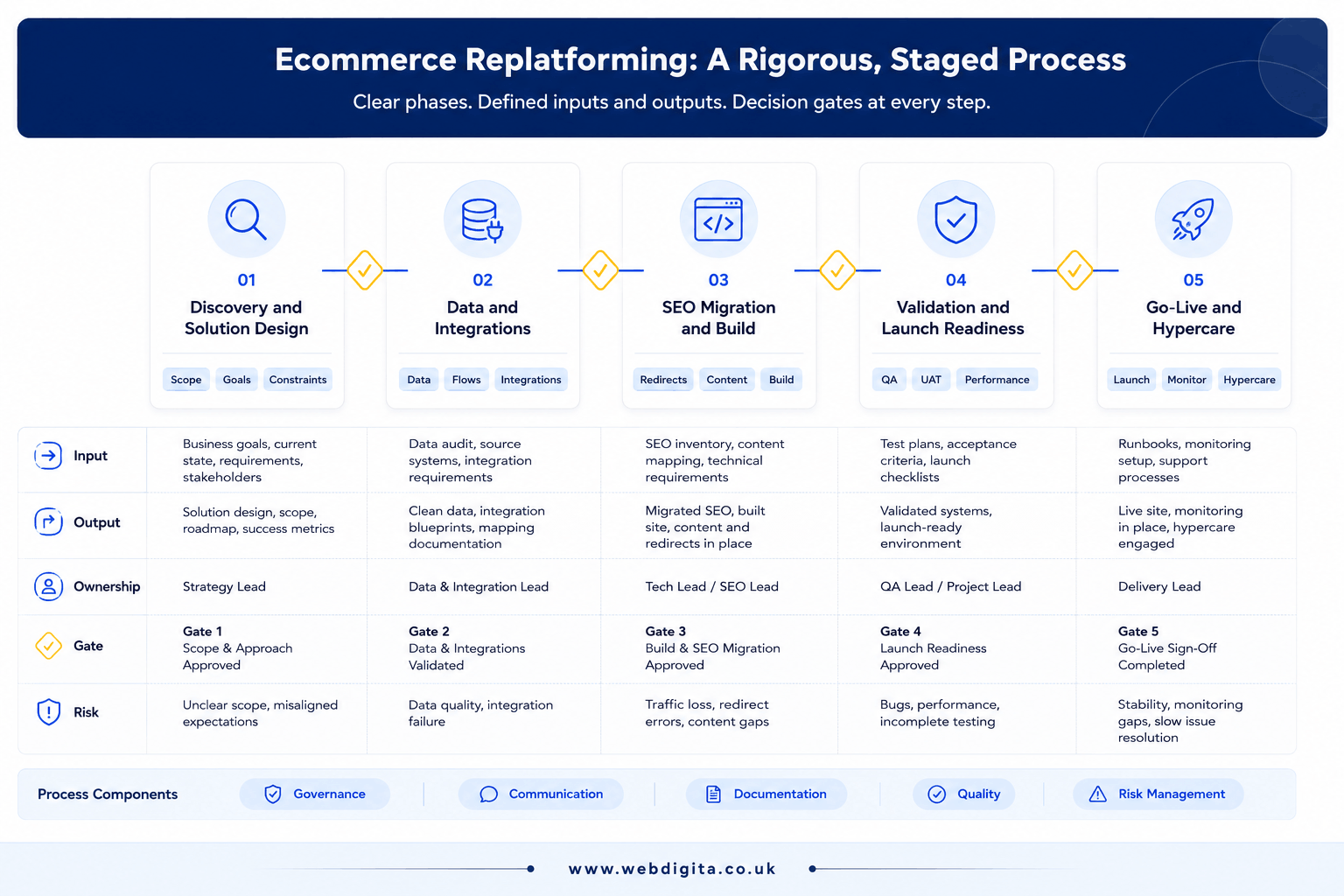
Process flow: phases, inputs, outputs, and decision gates
Discovery and solution design: input is the current estate, business goals and constraints. Output is a signed-off solution shape, scope logic and ownership map. Platform fit should be settled here, not revisited during build. If that upstream decision is still loose when build starts, the platform selection process has not been finished – it has just been deferred to your timeline.
Data and integration planning: input is source data, system rules and connector behaviour. Output is integration mapping, validation rules, integration remapping and exception handling. Do not assume old connectors can be lifted across. Pricing, stock, fulfilment, tax and customer account logic frequently need redesign. Anything described as a lift-and-shift is either simple enough that it barely matters, or complex enough that the description is wrong.
SEO migration planning and build: input is the approved architecture, URL logic and content requirements. Output is the working storefront, redirect implementation plan and preserved search signals. Ask how redirects will be implemented and tested in the real environment – not just exported to a spreadsheet and filed as done.
Validation, launch readiness, go-live and hypercare: input is the staging build, migrated data and approved test scripts. Output is a launch decision, monitored go-live and stabilisation plan. Ask what triggers launch approval, who can stop release, and how hypercare will be managed once real orders start flowing.
If you want this stage to involve actual ownership rather than a polite workshop, push for structured eCommerce migration project discovery workshop support with named owners, assumptions logged and sign-off points that mean something.

Not sure if your current estate is properly documented?
Most replatforming problems start before build, when legacy logic, integration dependencies and data quality risks are still hidden. We can help you map what needs to be understood before scope is locked.
No obligation. Just a structured conversation about what matters first.
The controls that protect data, SEO, and launch stability
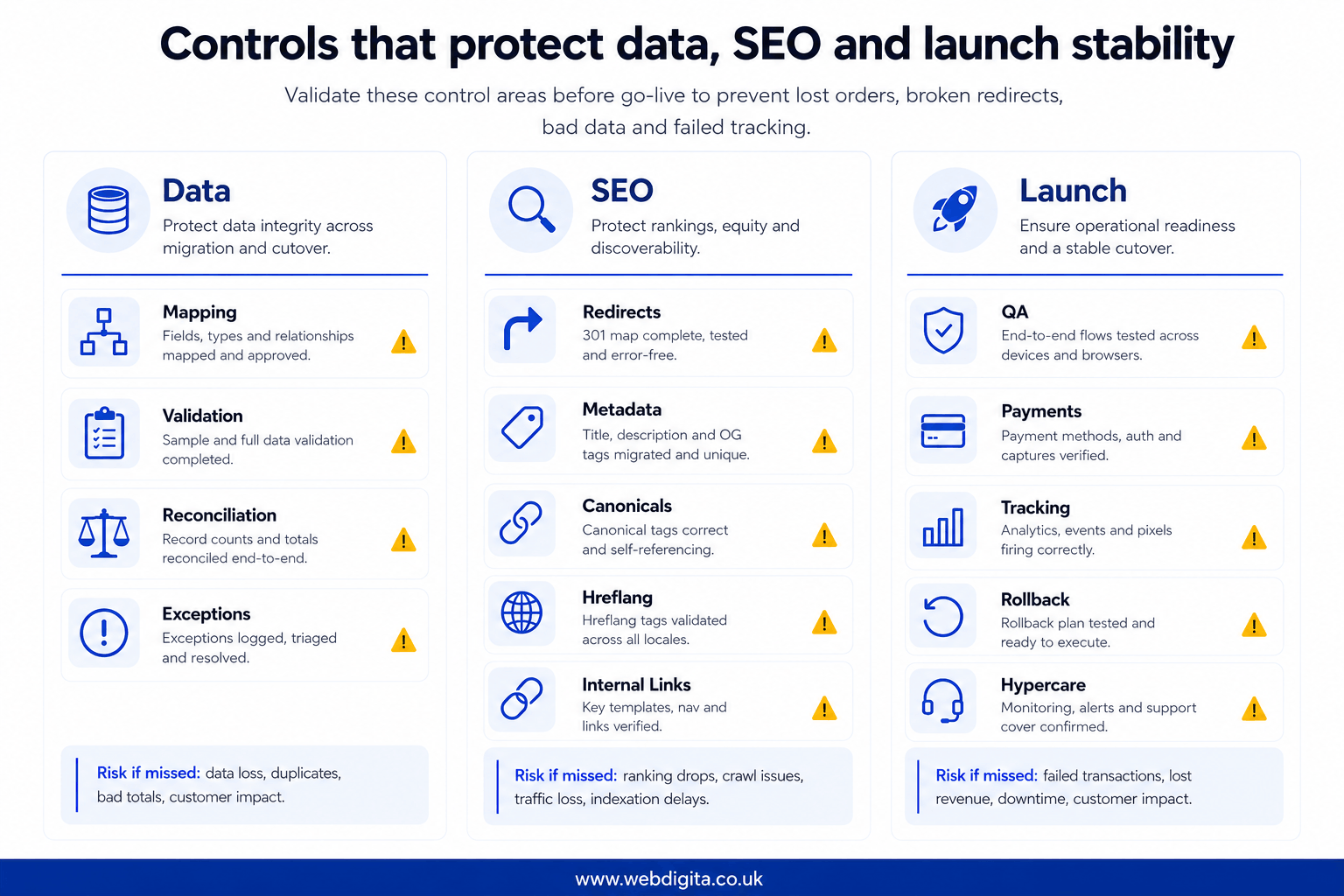
This is where weak process shows itself most reliably. Suppliers talk confidently about data migration, then treat validation as a late QA task somebody will sort before go-live. You need to separate data control, SEO control and launch control – because each one fails in its own unpleasant way when it is not owned.
Data migration: ask how source fields map to target fields, what gets transformed, what gets dropped, and how totals will be reconciled. A proper ecommerce platform migration includes trial runs, exception reporting and validation against source systems before any go-live conversation starts. If you are not sure whether your source data is clean enough, assessing data readiness before migration scope is locked is worth doing before you find out the hard way.
SEO preservation: redirect strategy, metadata continuity, canonicals, internal linking logic and hreflang cannot be left until the end. Treating SEO migration as a post-launch tidy-up is how you hand three months of ranking recovery to a team that had nothing to do with the build. Any supplier who frames it that way is telling you something important about how they prioritise your risk.
If an eCommerce agency promises a low-risk launch without a rollback path, they are describing hope, not process.
Post-migration QA should cover at least:
- Browse, search and filter journeys
- Basket, checkout, payment and order confirmation
- Customer account areas and password flows
- Stock, pricing and promotion behaviour
- ERP, PIM, CRM and fulfilment integrations
- Tracking, feeds and core reporting events
You also need a rollback plan with trigger criteria, decision owners and technical steps documented before launch day. “We will monitor closely” is not a rollback plan. Ask what specific failure mode would pause or reverse the launch – and get the answer in writing.
How to tell if an agency is skipping the hard parts
A rigorous supplier sounds different quite early. They ask awkward questions, challenge assumptions and keep pulling the conversation back to ownership, dependencies and validation. The shortcut-led version is usually smoother in the sales call and considerably rougher in delivery.
If you are evaluating proposals, watch for: vague discovery that produces no legacy logic inventory, thin integration detail that treats connectors as checkbox items, no redirect implementation plan (just a promise to handle it), soft QA language with no defined pass/fail criteria, and hypercare treated as something that gets agreed later. I would also push hard on timeline confidence. A real timeline depends on discovery findings, data quality, integration complexity and how quickly your team can review staging and complete UAT sign-off. A supplier who quotes timelines before discovery is either very lucky or not planning to hold the date.
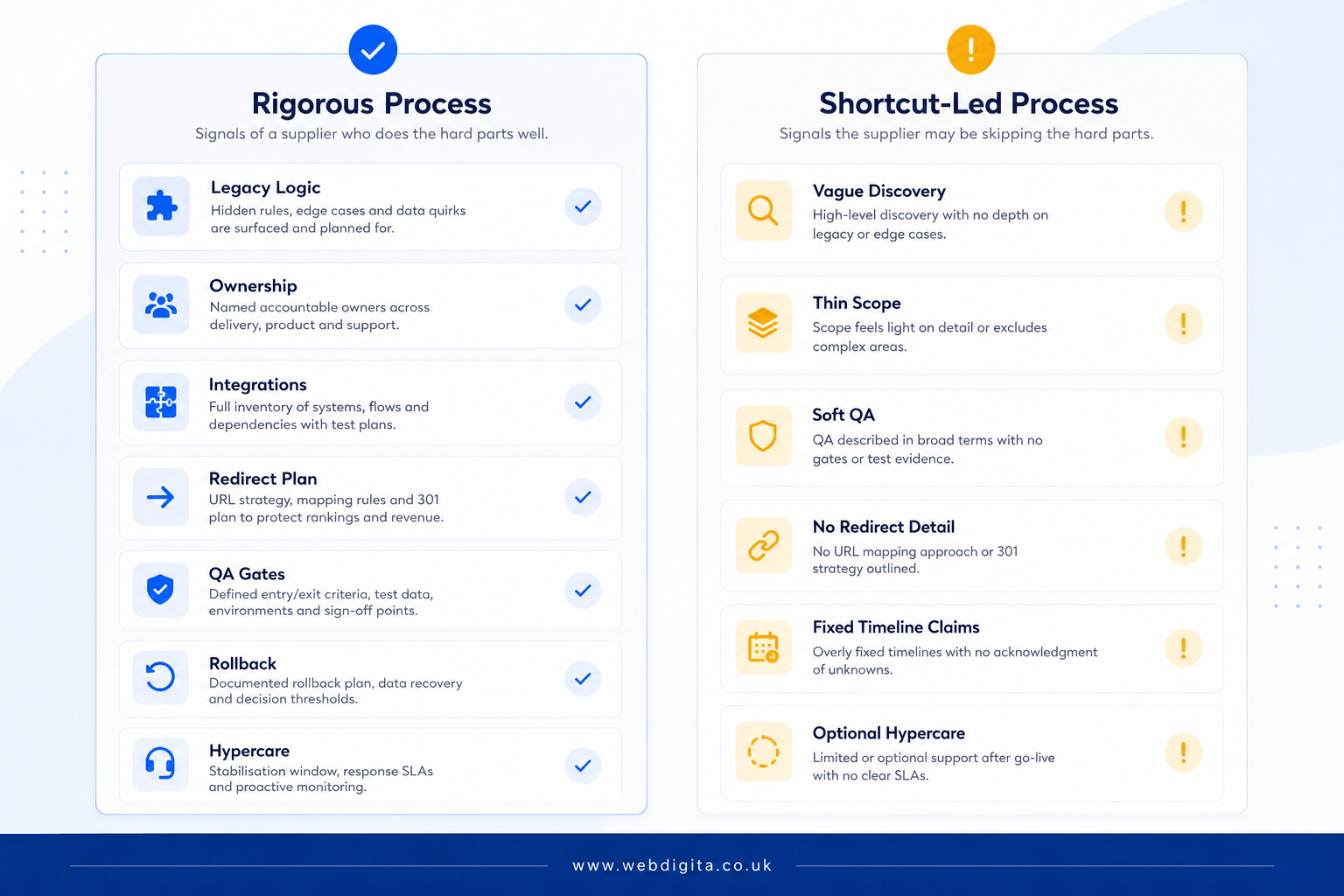
Replatforming rigour checklist: use this to test whether a supplier is describing a real delivery process or a hopeful sequence of meetings.
- Can they explain legacy debt capture beyond pages and products – including ERP behaviour, pricing rules and account logic?
- Have they separated data migration, integration remapping and SEO migration as distinct workstreams with separate owners?
- Can they show approval gates before build, before UAT and before go-live – with criteria, not just milestones?
- Do they describe working staging checkpoints rather than promising a fixed demo cadence?
- Can they walk through rollback triggers, hypercare ownership and what happens after launch week without looking uncertain?
The uncomfortable truth is that clients compare suppliers on platform familiarity and headline cost first. Process maturity is what decides whether the budget holds. If you want to understand what actually drives the cost of a replatforming project, it is almost always buried in discovery depth, integration risk, data quality and validation discipline – not the licence fee.
Once the site is live, post-go-live support boundaries matter more than most teams expect. Ask who owns defect triage, monitoring, fixes and release control after launch, especially if ongoing eCommerce maintenance is not already scoped. A supplier who cannot walk through that calmly and in detail has either not planned for it or is hoping you will not notice until you need it.
Questions teams ask before starting an ecommerce replatforming project
Practical answers about process, risk, ownership and what actually decides whether a replatforming project stays on track.
1. What should happen during discovery before a replatforming project starts build?
Discovery should document legacy logic, integration dependencies, data source mapping, SEO requirements and scope boundaries before any development begins. This includes capturing undocumented business rules, ERP pricing behaviour, operational workarounds and edge cases that will surface later if missed. The output should be a signed-off solution shape, ownership map and clear approval gate before build starts, not a vague requirements list that evolves during sprints.
2. How should data migration be validated during an ecommerce replatforming project?
Data migration should include trial runs, field-level mapping documentation, transformation logic, exception reporting and reconciliation against source systems before go-live. You need to know what gets transformed, what gets dropped, and how totals will be validated. Proper validation means testing migrated data in staging, checking customer accounts, order history, pricing rules and product attributes against the old system, not just counting rows.
3. What does a proper SEO migration plan look like for replatforming?
A proper SEO migration plan includes redirect strategy, implementation planning, testing in the real environment, metadata continuity, canonical logic, internal linking preservation and hreflang where relevant. Redirects should be implemented and tested before launch, not exported to a spreadsheet and treated as post-launch tidy-up. The plan should cover URL mapping, 301 redirect rules, validation of redirect chains, and monitoring of search visibility and crawl behaviour after go-live.
4. What should a rollback plan include for an ecommerce replatforming launch?
A rollback plan should include specific failure triggers, decision owners, technical steps to reverse the launch, and criteria for pausing or stopping go-live. This means defining what level of checkout failure, integration error, payment issue or order processing breakdown would trigger rollback, who has authority to make that call, and how quickly the old platform can be restored. Vague promises to monitor closely are not a rollback plan.
5. How long should hypercare last after an ecommerce replatforming launch?
Hypercare typically lasts two to four weeks after launch, depending on trading volume, integration complexity and how quickly issues stabilise. During this period, you need dedicated resource for defect triage, monitoring, urgent fixes and release control. The hypercare plan should define who owns incident response, what counts as a critical issue, how fixes will be prioritised and deployed, and when the project formally hands over to business-as-usual support.
6. What are the warning signs that a replatforming supplier is skipping the hard parts?
Warning signs include vague discovery scope, thin integration detail, no redirect implementation plan, soft QA language, hypercare treated as optional, and timeline confidence before discovery findings are known. If a supplier starts talking about build sprints before they can explain how they will document your current logic, or promises a low-risk launch without a rollback path, they are describing hope rather than process. Push on approval gates, validation discipline and post-launch ownership.
7. Should integrations be treated as lift-and-shift during replatforming?
No. Pricing, stock, fulfilment, tax and customer account logic often need redesign, not lift-and-shift. Old connectors rarely map cleanly to new platform architecture, especially if ERP rules, customer group pricing or tax behaviour are embedded in the current integration. Integration remapping should be a separate workstream with its own planning, validation and testing, not assumed to be a simple reconnection task.
8. What should be tested during UAT before an ecommerce replatforming launch?
UAT should cover browse, search, filter, basket, checkout, payment, order confirmation, customer account areas, password flows, stock behaviour, pricing logic, promotions, ERP integration, PIM sync, CRM data flow, fulfilment handoff, tracking events and core reporting. Testing should use real scenarios, edge cases and exception handling, not just happy-path journeys. Sign-off should be formal, with named owners and documented test results, not a polite workshop.
Conclusion
- A rigorous replatforming process protects you from late rework, scope creep and launch instability by surfacing hidden dependencies, data risks and integration complexity before build starts, not during it.
- The suppliers who ask awkward questions early, challenge assumptions and keep bringing the conversation back to ownership and validation are usually the ones who deliver cleanly, while the smoother sales pitch often leads to rougher delivery.
- If you are comparing proposals, push hardest on discovery depth, approval gates, rollback planning and hypercare ownership because those are the areas where weak process shows itself once real orders start flowing.
- Before you sign anything, make sure you can explain who owns legacy logic capture, how redirects will be implemented and tested, what triggers launch approval, and what happens when something breaks in week two.
Ready to start a replatforming conversation with a team that documents before they build?
WEBDIGITA runs ecommerce replatforming as a staged programme with clear discovery, data migration planning, SEO preservation, integration remapping and post-launch hypercare. We work with mid-market and enterprise retailers who need rigour, not shortcuts.
See our eCommerce replatforming approachOr if you prefer,