eCommerce project timelines are rarely wrong about the build. They are always wrong about the integration. I have been shipping ecommerce builds across Shopify, WooCommerce, Magento, and headless commerce stacks for over two decades. The pattern does not change: the storefront itself is usually fine. It is ERP sync, product data chaos, checkout edge cases, and the three stakeholders who need to sign off on every shipping rule that eat the schedule.
The short answer: eCommerce development in the UK takes 8 to 10 weeks for a tightly scoped Shopify or WooCommerce build. Mid-market projects with integrations, migration, or B2B requirements run 4 to 8 months. Magento, Adobe Commerce, headless, and complex B2B builds often run longer. The number depends almost entirely on integration risk, internal ownership, and how clean your product data is before build starts.
If you are comparing providers or planning with an eCommerce development team, judge the timeline by its assumptions and dependency list – not by how clean the delivery number looks in the proposal.
What is a realistic UK ecommerce development timeline?
A realistic timeline depends less on raw build effort and more on everything around it. Platform choice matters, but so do architecture decisions, ERP integration readiness, catalogue complexity, internal approval cycles, and testing depth.
Tightly scoped builds: 8 to 10 weeks can hold for a smaller Shopify or WooCommerce setup with clean product data and limited custom logic. Add ERP sync, migration, B2B pricing tiers, or non-standard checkout behaviour, and that range starts to break at the seams.
Mid-market projects: 4 to 8 months is more realistic when the store has operational weight behind it – multiple payment and shipping rules, VAT handling, customer account logic, and anything requiring proper integration testing rather than a quick connection check.
Build time is rarely the problem. Integration risk, review cycles, and edge cases are what turn a tidy estimate into a late launch and a stressed client relationship.
Complex programmes: Magento, Adobe Commerce, headless commerce builds, larger B2B eCommerce projects, and replatforming from legacy systems run longer because architecture decisions create downstream consequences that do not show up in the first three weeks. A guaranteed launch date on a complex build is a warning sign, not a reassurance.
Where the time actually goes from discovery to launch
Credible timelines are built phase by phase, not lifted from a sales deck. The detail you want to see is where time is allocated for discovery, architecture, UX, development, integrations, data migration, testing, launch readiness, and post-launch stabilisation – as separate named items, not as implied steps under a vague delivery phase.
Some work overlaps legitimately. Design and technical environment setup can run in parallel. Integration testing, checkout validation, security review, and load testing cannot be crushed into the final week without creating real risk. I have seen teams try it. The post-launch defect list tells the story.
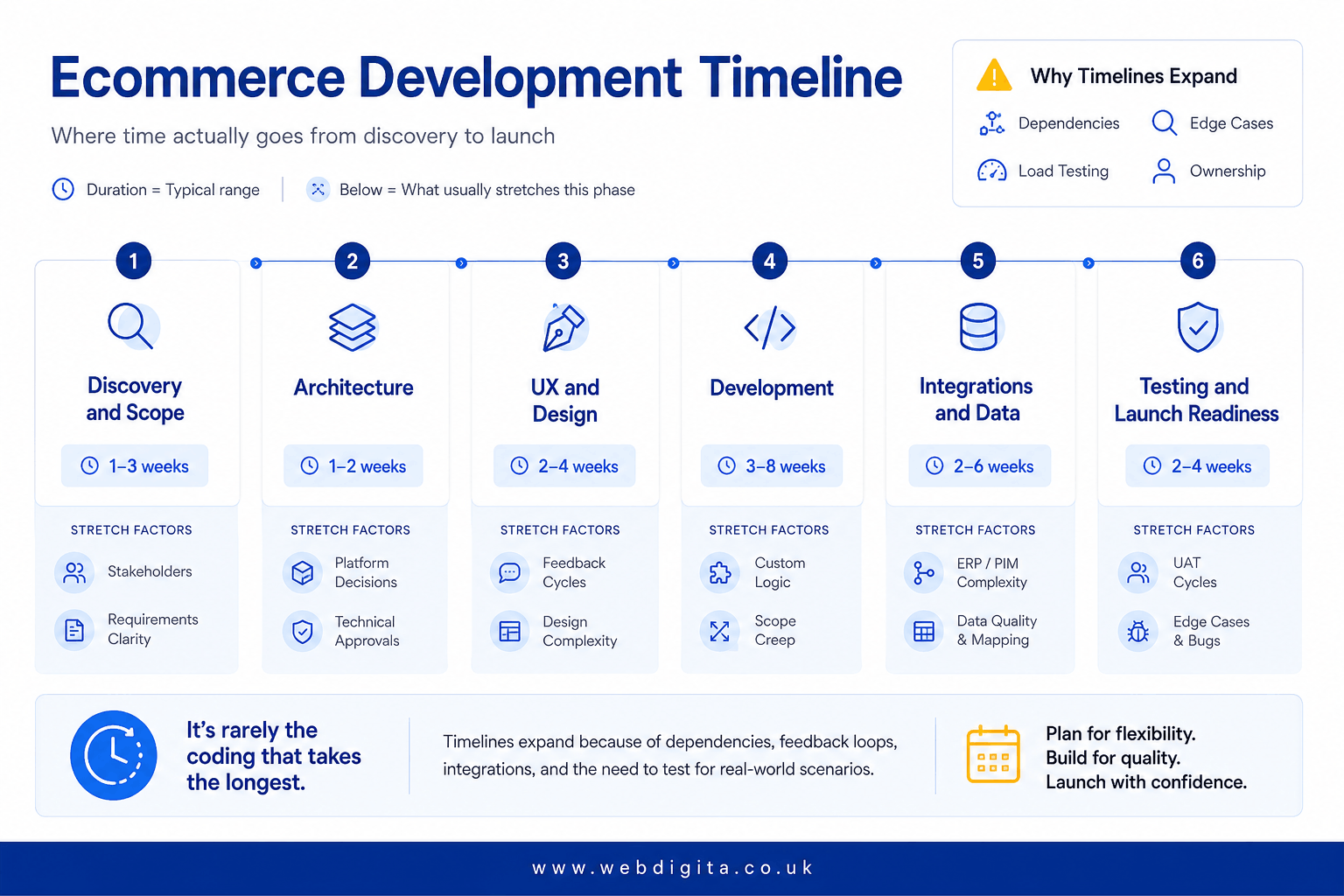
Typical ecommerce project phases and what stretches them:
Discovery and scope: 1 to 3 weeks. Slows when requirements are vague, stakeholders disagree, or integration dependencies are still being guessed. If this phase is skipped entirely, the rest of the timeline is fiction.
Architecture and solution design: 1 to 2 weeks. Grows when platform choice is unsettled, B2B eCommerce capability is unclear, or headless commerce is being discussed without a clear technical rationale.
UX and design: 2 to 4 weeks. Expands when journey definitions, page templates, or approval rounds keep changing.
Development: 3 to 8 weeks. Stretches with custom features, checkout logic, account hierarchy complexity, and technical debt from decisions made too early or too cheaply.
Integrations and data: 2 to 6 weeks. This is where most plans fall apart. ERP integration, PIM connections, stock sync, pricing rules, and fulfilment logic each carry their own risk. When they are all happening at once, delays compound.
Testing and launch readiness: 2 to 4 weeks. Gets longer when UAT starts late, performance issues surface under load testing, or payment and shipping edge cases were not scoped in the first place.
If the store is expected to handle campaign spikes, large catalogues, or B2B traffic patterns, checkout performance testing, security checks, and scalability work need named time in the plan. Hiding that work under a generic QA label is how teams end up nervous the week before go-live.

Not sure if your timeline assumptions are realistic?
We can review your brief, flag the dependencies that usually stretch delivery, and help you set expectations that hold up under scrutiny. No sales pressure, just a clear view of what the timeline should actually account for.
Used by project leads who need honest answers before committing budget.
What usually extends the timeline more than buyers expect
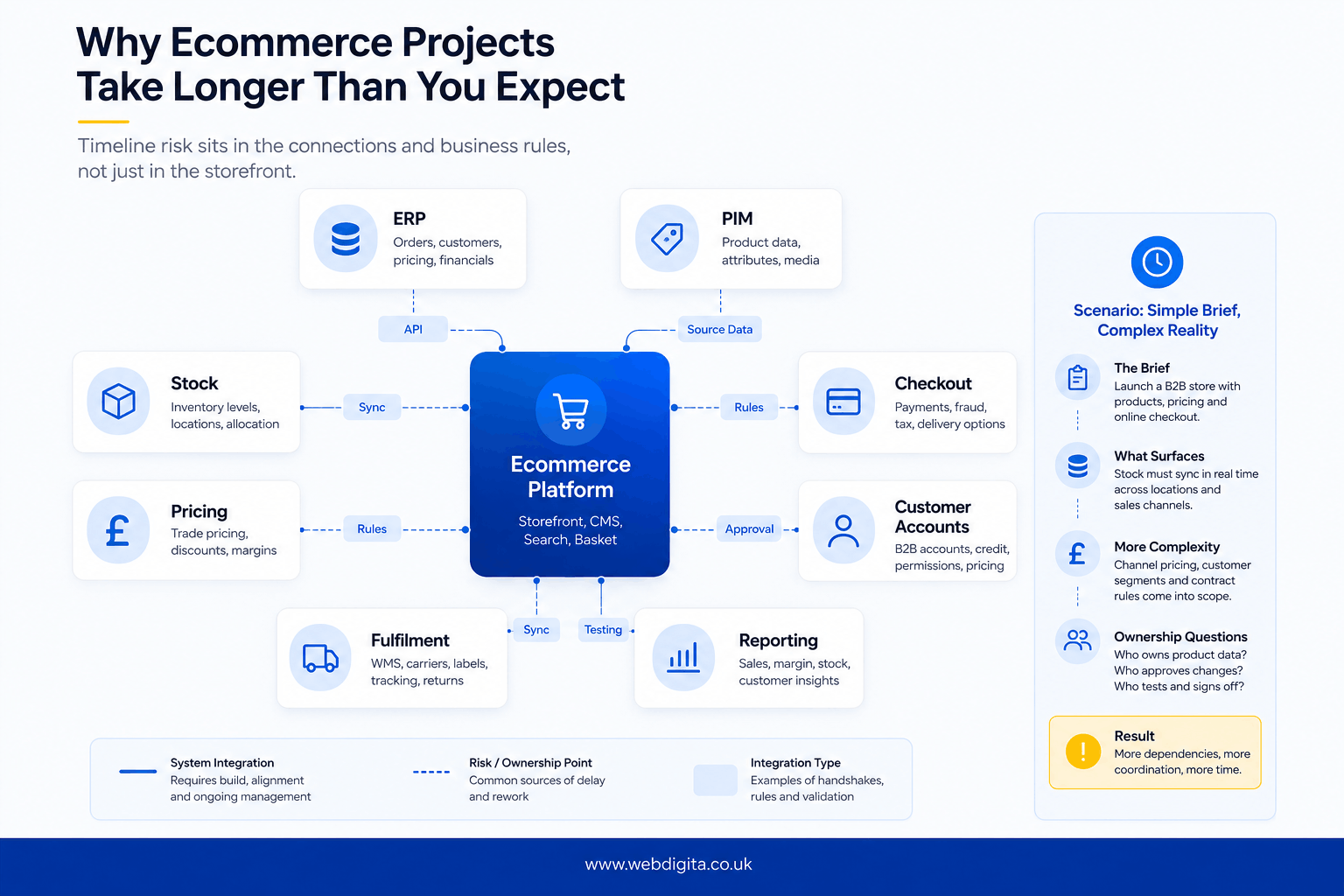
The honest problem is rarely the storefront itself. It is usually the systems behind it. Orders, stock, pricing, customer accounts, fulfilment, and reporting all have to move cleanly between the ecommerce platform and everything else.
ERP integration is where most tidy plans fall apart. If the ERP team is slow to engage, the API is underdocumented, or key business rules live in somebody’s head rather than a written spec, the build team ends up waiting, reworking, and retesting the same flows. I have watched six-week estimates for an integration phase stretch to fourteen weeks because nobody asked the hard questions about data ownership before build started. If you want to reduce that risk, read more about planning integrations before development starts.
Product data model design is another quiet timeline killer. Categories, variants, bundles, filters, pricing tiers, and merchandising rules all interact. If that logic is messy or inconsistent, it affects search, navigation, migration, and admin setup simultaneously – and each fix has a downstream knock-on.
B2B eCommerce capability adds a separate layer of complexity. Account hierarchies, customer-specific pricing, approval workflows, quote requests, credit terms, and restricted catalogues are not small add-ons. They change architecture, testing scope, and long-term maintainability in ways that are not visible in a standard project quote.
A common failure pattern looks straightforward at first: the brief says new storefront, data migration, and a few integrations. Then stock sync rules surface, customer group pricing behaves differently by channel, and nobody can agree which system owns the source of truth.
The red flags that make a timeline hard to trust
If a timeline sounds clean but feels thin, trust that instinct. Weak assumptions are how scope drift gets dressed up as confidence.
- No discovery or requirements clarification time – the phase that prevents everything else from going wrong
- Integrations described vaguely or marked as “to be confirmed” – which means unpriced and unscoped
- No allowance for product data cleanup or migration mapping
- No clear UAT window or no named owner on your side
- Guaranteed launch dates with no dependency log, no contingency, and no explanation of what happens if either slips
- Checkout performance testing, security review, or load testing buried under a generic QA label
Three or more of those and the timeline is a commercial risk, not a delivery plan. My view, having reviewed more proposals than I would like to count: any estimate that describes phases too neatly has been written for the pitch, not for the project. Real ecommerce delivery has review loops, dependency waits, and failure modes that do not fit a perfect staircase diagram.
If the provider cannot clearly distinguish which delays belong to them and which belong to your team, the estimate is not mature enough to commit to. For a deeper look at where pre-build slippage originates, see why eCommerce projects often stall before build even begins.
How much time your own team needs to give the project
This is the part buyers consistently underestimate. Product data review, content creation, image gathering, policy decisions, shipping logic, tax configuration, and stakeholder approvals are not the agency’s job. They are yours. The build team cannot invent those for you, and they cannot move forward when those inputs are missing.
Teams often assume the build partner carries the full project until ownership becomes explicit in a responsibility matrix. Once approvals, data delivery, and integration access have clear owners with dates attached, a significant share of avoidable delay disappears.
UAT is where rushed projects expose themselves. Late testing creates rework at the point when changes are most expensive and most disruptive – the final two weeks before go-live. This is especially common in founder-led businesses where decisions still take several days because legal, operations, and marketing all need to review different parts of the same change.
If you are reviewing quotes now, it also helps to look carefully at what scope should be included before any eCommerce quote is signed. A well-scoped brief tells you more about timeline realism than the headline delivery date ever will.
How to set a launch date that does not collapse under delivery pressure
The safest launch dates are confirmed after scope, integration dependencies, and internal ownership are settled in writing – not before. Locking a seasonal campaign or major marketing push to a build date that was agreed before architecture and integration risk were properly understood is one of the most reliable ways to manufacture a crisis.
Here is the discipline that actually holds:
Define conditions, not hope: name the critical dependencies, approval turnaround times, testing windows, and contingency before you commit publicly. If a fixed commercial date is non-negotiable, a phased launch is usually the safer engineering decision – core commerce live first, lower-priority features released after a stabilisation window.
Treat headless and front-end framework decisions as timeline variables: choosing a headless commerce architecture or a newer front-end framework mid-project is not a style preference – it is a scope change. If those decisions are still open when build starts, the timeline is already at risk. For context on how those choices affect delivery and cost, see the guide on eCommerce front-end framework selection, what a headless eCommerce development process should actually look like, and what actually drives headless eCommerce development cost in the UK.
Know your post-launch exposure: understand what happens after go-live, who handles defects, how warranty boundaries are defined, and whether you have eCommerce maintenance coverage lined up if the store needs rapid fixes after launch.
If you want a timeline you can actually trust, ask for the assumptions in writing, ask who owns each dependency, and ask what has been deliberately left out of scope. That conversation is almost always more useful than another optimistic estimate.
If you are at the stage of shortlisting agencies, the questions that reveal actual delivery competence are worth understanding before you sign anything. See the guide on how to choose an eCommerce development agency.
Questions buyers ask about eCommerce development timelines
Common concerns about planning realistic delivery schedules and avoiding late launches
1. How long does a typical Shopify eCommerce build take in the UK?
A tightly scoped Shopify build with clean product data and limited custom logic can take around 8 to 10 weeks. That assumes straightforward payment and shipping rules, no heavy ERP integration, and a clear approval process. Add B2B pricing, custom checkout behaviour, migration, or stock sync, and the timeline extends into the 3 to 6 month range depending on complexity and integration depth.
2. Why do eCommerce projects take longer than the initial estimate?
Most delays come from integration dependencies, unclear business rules, product data cleanup, and slow approval cycles rather than slow development. ERP sync, customer-specific pricing, and stock rules often take longer because system ownership is split or the logic is not documented. Late UAT, changing requirements, and missing content also push timelines back without adding visible build progress.
3. What is a realistic timeline for a mid-market eCommerce project?
Mid-market projects with heavier operational requirements typically take 4 to 8 months. That includes discovery, architecture, design, development, integrations, data migration, testing, and launch readiness. The timeline grows when the store needs multiple payment and shipping rules, VAT handling, customer account logic, B2B capability, or deeper ERP integration. Rushed timelines in this range usually mean testing or integration work was underestimated.
4. How much time should we allow for testing before launch?
Testing and launch readiness usually need 2 to 4 weeks, but that grows when UAT starts late or performance issues appear under load. Checkout validation, payment and shipping edge cases, security review, and load testing cannot be crushed into the final week without creating risk. If the store is expected to handle campaign spikes or larger catalogues, scalability testing needs named time in the plan.
5. What are the red flags in an eCommerce development timeline?
Red flags include no discovery time, vague integration descriptions, no allowance for product data cleanup, no clear UAT window, and guaranteed launch dates with no dependency log or contingency. If checkout performance, security, or load testing is buried under a generic QA label, or if the provider cannot explain which delays belong to them and which belong to you, the estimate is not mature enough to trust.
6. How long does Magento or Adobe Commerce development take?
Magento and Adobe Commerce projects usually take longer than Shopify or WooCommerce because architecture decisions create downstream consequences. Expect 6 to 12 months or more for serious builds, especially when B2B capability, complex pricing, heavy integration, or replatforming is involved. A guaranteed launch promise here is usually a warning sign, not a strength, because the platform requires deeper technical planning and testing.
7. How much time does our internal team need to give the project?
Your team needs time for product data review, content creation, image gathering, policy decisions, shipping and tax rules, stakeholder approvals, and UAT. If approvals, data, and integration access do not have clear owners with realistic turnaround times, the project slows in short, frustrating bursts. Late testing creates rework near launch, when changes are more expensive and more disruptive.
8. Can we launch in phases to reduce timeline risk?
Yes, phased launches are often safer when you need a fixed commercial date. Launch core commerce first, then release lower-priority features after stabilisation. This reduces the risk of betting a major campaign or seasonal push on a build date agreed before architecture and integration risk are fully understood. Post-launch support and defect handling should be clearly defined before go-live.
Conclusion
Most eCommerce timelines fail because they treat the build as the whole project. The real delays come from integration dependencies, data quality, approval cycles, and testing depth that was never properly scoped.
A credible timeline explains where time goes, who owns each dependency, and what happens when something slips. If the estimate cannot explain that, it is not mature enough to trust.
Before you commit to a launch date, ask for the assumptions in writing, ask who owns each dependency, and ask what has been left out. That conversation usually tells you more about delivery realism than another optimistic estimate. If you are planning a build now, make sure discovery, integration planning, and UAT windows are named in the timeline, not hidden under generic phases. The projects that launch cleanly are the ones where risk was surfaced early, not the ones where the sales number looked tidiest.
Ready to plan an ecommerce build that accounts for the real dependencies?
WEBDIGITA helps UK businesses scope, architect, and deliver ecommerce projects with clear timelines, integration planning, and testing depth built in from the start. We work with Shopify, WooCommerce, Magento, and headless commerce across mid-market and B2B requirements.
See our eCommerce development workOr speak to us about